
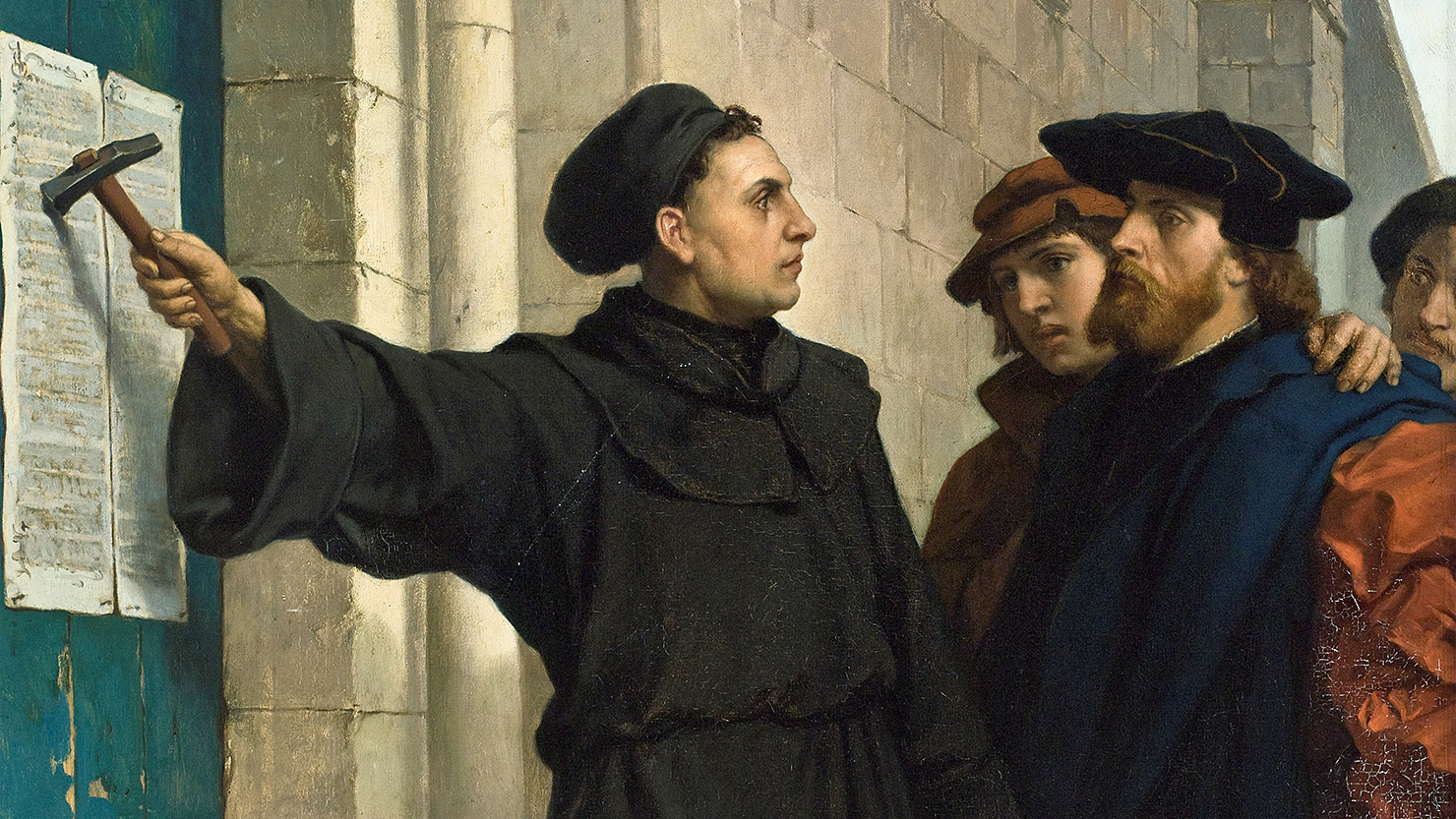
On October 31, 1517, something happened at a door in Wittenberg, Germany … and it was not children in costumes knocking on it in hopes of getting Halloween candy. Instead, a monk named Martin Luther showed his dissatisfaction and grief over the abuses of the Roman Catholic Church by nailing a statement to the church door. The statement is known as the Ninety-Five Theses, intended to spark debate and bring about positive change within the Catholic Church. Luther did not do this as a means to split the church but with the desire to heal the church and bring it back in line with Scripture.
Due to the religious/political climate and with the advent of the printing press, Luther’s words gained a wider audience in Germany turning his document into a manifesto decrying the abuses in the church and creating a crisis within the church that eventually did lead to some reforms, but more immediately led to Martin Luther being tried for heresy and excommunicated.
This, of course, was not the end of Martin Luther’s story, and so much has been written that I will forgo the effort in this short post. I would, however, encourage you to take the time to read up on Martin Luther and the Protestant Reformation. He was part of a movement that radically reshaped the face of Christianity, made the Scriptures accessible to all who could read, and highlighted salvation by grace through faith in Jesus rather than through works or religious observance.
Through the work of Luther and other reformers and theologians, the Protestant church stands on five (not 95) statements called the five solas:
Sola Scriptura (Scripture alone)
Solus Christus (Christ alone)
Sola Fide (faith alone)
Sola Gratia (grace alone)
Soli Deo Gloria (glory to God alone)
Although October 31 is primarily recognized as the celebration of Halloween, the celebration of Reformation Day is (in my estimation) far, far more significant and weighty … and worthy of our attention and appreciation.

 beyond the sermon
Leave a comment