
Sermon Summary: The Two Witnesses
Revelation 11:1–14
Main Idea:
In a chaotic and rebellious world, God plants two faithful witnesses in the very heart of Jerusalem. Their prophetic ministry, death, resurrection, and ascension demonstrate that God’s purposes will prevail, even in the darkest days of the Great Tribulation.
1. God Measures What Is His (vv. 1–2)
“Rise and measure the temple of God and the altar and those who worship there…”
John is given a measuring rod—a symbol of ownership, protection, and purpose. He is told to measure:
- The temple (Greek naos – the inner sanctuary)
- The altar
- The worshipers
But not the outer court—it is handed over to the nations for 42 months (3½ years), signaling judgment.
Interpretations of the Temple:
- A literal rebuilt temple in Jerusalem during the Tribulation
- A symbolic representation of the people of God (supported by NT references to believers as God’s temple)
John’s measuring emphasizes that God knows, owns, and guards His true worshipers—especially during seasons of judgment.
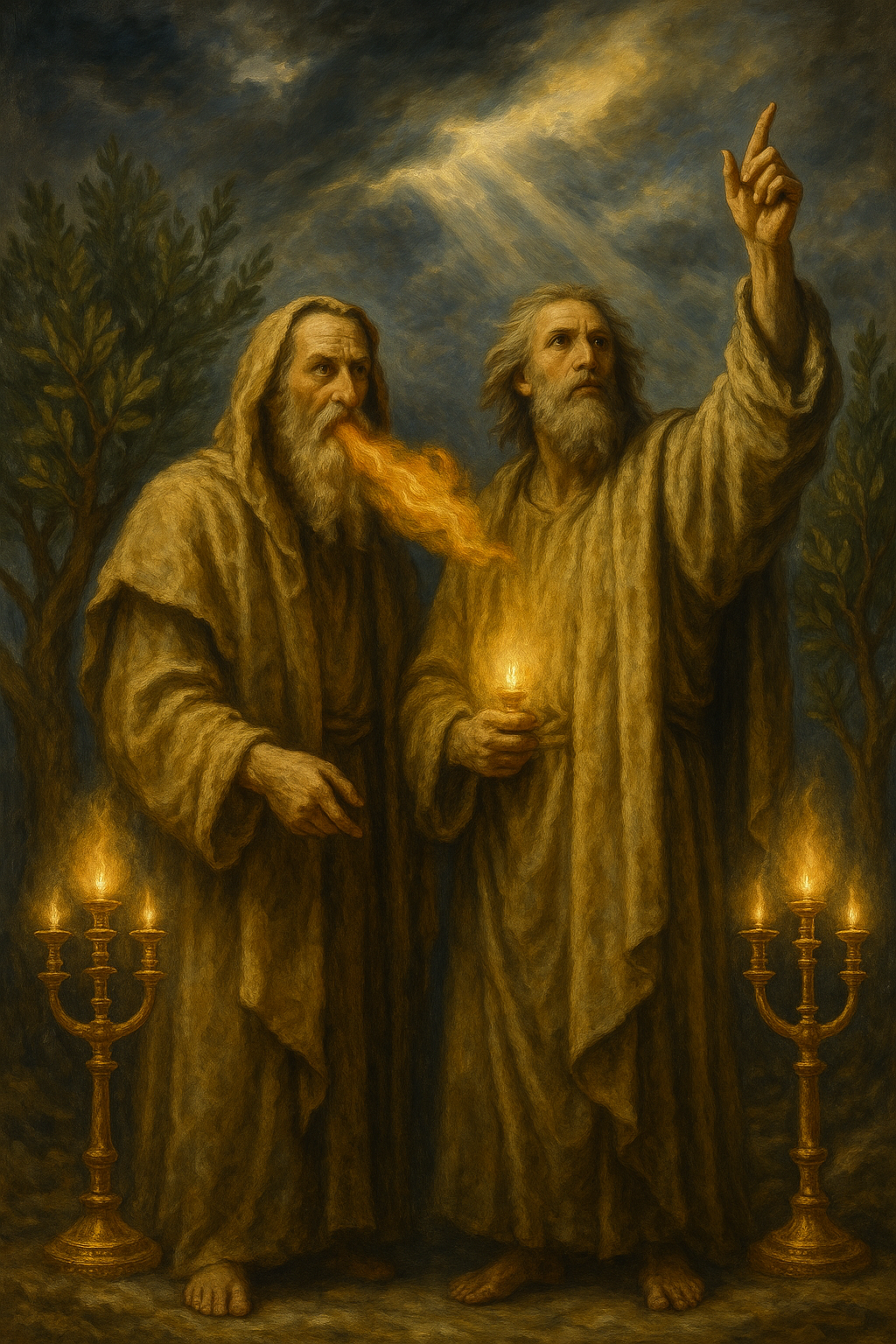
2. God Sends His Witnesses (vv. 3–6)
“I will grant authority to my two witnesses…”
Two prophets are appointed to preach in Jerusalem for 1,260 days (3½ years)—likely during the first half of the Great Tribulation.
- Clothed in sackcloth: Symbol of mourning and a call to repentance
- Ministry message: Likely includes repentance, judgment, and the soon return of Christ
- Described as:
- Two olive trees and two lampstands (Zechariah imagery—God-empowered witnesses bringing light)
- Prophets with power like Moses and Elijah:
- Fire from their mouths
- Power to cause drought
- Turning water into blood
- Calling down plagues
Identity?
- Moses & Elijah? (Law & Prophets)
- Enoch & Elijah? (Never tasted death)
- Two unnamed future prophets?
Regardless of identity, their mission is clear: to speak truth boldly with divine authority and protection.
3. God Allows Their Death—But Not Defeat (vv. 7–10)
“When they have finished their testimony…”
Their death:
- Occurs only when their mission is complete
- Comes at the hands of the beast from the abyss (first mention of Antichrist)
- Happens in Jerusalem, symbolically called:
- Sodom (for rebellion and depravity)
- Egypt (for oppression and hard-heartedness)
- Their bodies lie in the streets for 3½ days
- The world celebrates their death, exchanging gifts and rejoicing
The world rejects God’s messengers so thoroughly that their murder becomes a holiday.
4. God Raises Them and Shakes the City (vv. 11–13)
“A breath of life from God entered them…”
- They rise from the dead and stand up—stunning the world
- They hear, “Come up here!” and ascend to heaven in full view of their enemies
- A great earthquake strikes Jerusalem:
- A tenth of the city falls
- 7,000 people die
- The survivors give glory to God—suggesting some form of spiritual awakening or revival
5. Application: God’s Plan Will Not Fail
“The second woe has passed…” (v. 14)
Through the lens of these dramatic events, we are reminded:
- God is not absent in the chaos.
- His messengers are not silenced, even in death.
- His plan cannot be stopped, even by hell’s fury.
- His power is victorious, even over the grave.
Key Truth:
No matter how great the opposition, God will see His plan through to the end.
Questions for Reflection:
- Am I standing as a faithful witness in a world of compromise?
- Do I trust that God’s timing and power will prevail—even when it seems evil has the upper hand?
- If the end came today, would I be found on the side of the witnesses or among the mockers?
The world is noisy, crowded, and rebellious—but God has planted His truth right in the middle of it.
His witnesses will speak.
His plan will prevail.
Will you be counted among those who give Him glory?

 beyond the sermon
Leave a comment