
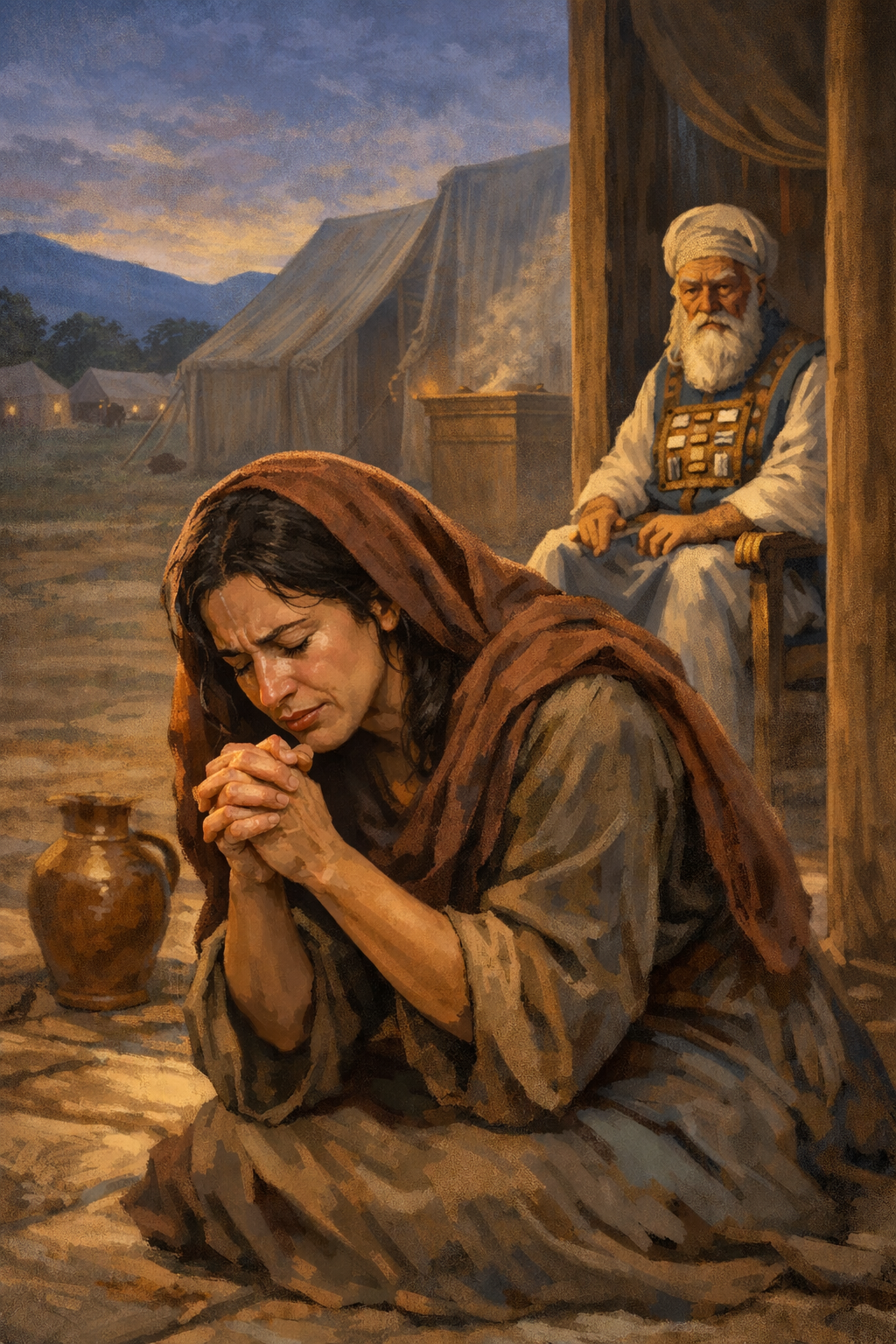
1 Samuel — A Mother Pouring Out Her Soul
1 Samuel 1
Big Idea: God advances His redemptive purposes not through power or position, but through humble faith, surrendered prayer, and ordinary obedience.
Setting the Scene
The book of 1 Samuel unfolds around 1050 BC, at a pivotal moment in Israel’s history—when God’s people move from the period of the Judges to the era of Kings. Yet the real crisis is not political leadership but spiritual rebellion.
“In those days there was no king in Israel. Everyone did what was right in his own eyes.” (Judges 21:25, ESV)
The absence of a human king exposed a deeper problem: the people refused to live under the lordship of the true King. Into this spiritually chaotic world, God begins His work—not with a throne or an army, but with a praying woman.
1. An Ordinary Family, A Deep Wound
(1 Samuel 1:1–8)
- Elkanah is introduced as “a certain man”—ordinary, historical, real.
- He has two wives:
- Peninnah – fruitful, but cruel.
- Hannah – loved, but barren.
- Scripture states plainly: “the LORD had closed her womb” (v.5).
Hannah’s suffering is intensified by:
- Social shame
- Ongoing provocation
- Private grief made public year after year
Despite Elkanah’s sincere love, he cannot heal her pain. Her ache runs deeper than reassurance—it reaches into her soul.
Theological Insight:
God anchors His redemptive work in real history and real pain. Hannah’s barrenness is not meaningless—it is purposeful.
2. A Broken Heart Poured Out Before the Lord
(1 Samuel 1:9–18)
Hannah does what Israel as a whole had failed to do—she listens for and submits to the Lord.
- She prays silently but intensely.
- She vows that if God gives her a son, she will give him back.
- She is misunderstood by Eli, the high priest, who mistakes her anguish for drunkenness.
Her response is telling:
“I have been pouring out my soul before the LORD.” (v.15, ESV)
This is not performative prayer. This is raw, honest, faith-filled surrender.
Key Turning Point:
Her circumstances do not change immediately—but her countenance does.
She leaves in peace because she has entrusted her burden to the Lord.
3. The Lord Who Remembers
(1 Samuel 1:19–20)
- Hannah asked God to remember her (v.11).
- Scripture testifies: “the LORD remembered her” (v.19).
She conceives and names her son Samuel, meaning “heard by God.”
Her answered prayer becomes a living testimony to the faithfulness of the Lord.
4. A Costly Faith Kept
(1 Samuel 1:21–28)
Hannah does not forget her vow.
- After Samuel is weaned (around age three), she brings him to Shiloh.
- She gives her long-awaited son back to the Lord.
- Her worship is costly, intentional, and obedient.
“For this child I prayed, and the LORD has granted me my petition… therefore I have lent him to the LORD.” (vv.27–28, ESV)
This is not resignation—it is worship.
Why This Story Matters
The book of 1 Samuel does not begin with a king on a throne but a woman on her knees.
- While Israel searched for leadership, God prepared it quietly.
- Through prayer, faithfulness, and brokenness, God raised up a prophet.
- Samuel would hear God’s voice, confront corruption, and anoint kings.
God’s pattern is clear:
He often does His greatest work through the humble, the faithful, and the surrendered.
Gospel Connection
Hannah gave her son to the Lord.
God gave His Son to the world.
Samuel would help guide Israel toward godly leadership.
Jesus, the true King, opens the way into the Kingdom of God.
Takeaways for Us
- Pour out your soul to the Lord—He hears.
- Trust God’s timing even when pain lingers.
- Surrender what matters most, believing God’s purposes are good.
- Never underestimate how God may use faithful obedience to shape His larger story.
Closing Thought:
When the world is loud and chaotic, God still listens for the quiet cry of faith—and He remembers.

 beyond the sermon
Leave a comment