
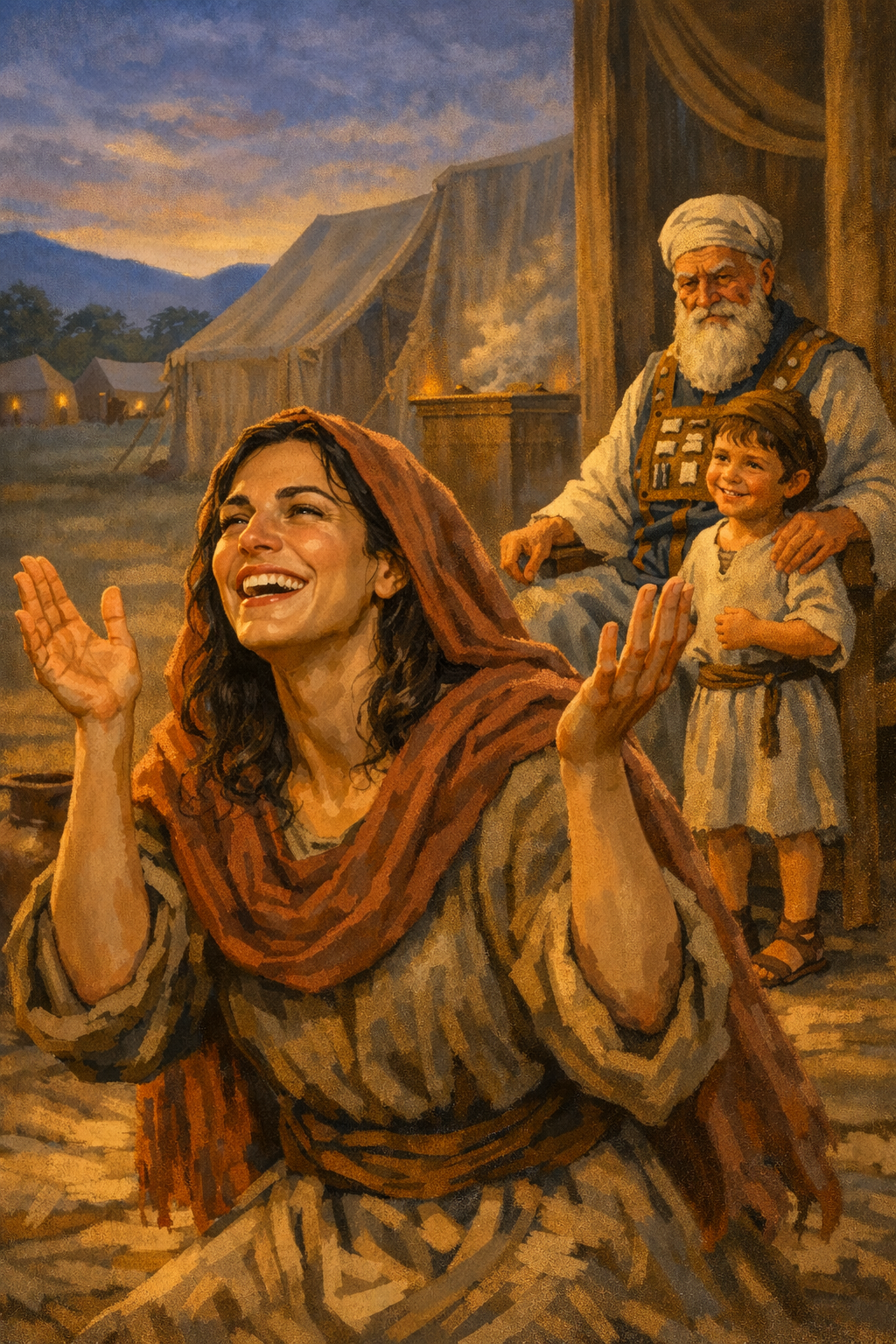
A Song of Surrender
1 Samuel 2:1–11
Main Idea
True prayer is not about getting what we want from God, but surrendering our hearts to who God is and trusting His sovereign purposes.
Overview
In 1 Samuel 2:1–11, Hannah lifts her voice in praise after giving her long-awaited son back to the Lord. This is not a prayer of request but a song of surrender. Once broken by barrenness and ridicule, Hannah now rejoices—not merely because her circumstances changed, but because her heart has been reshaped by the Lord. Her prayer reveals that God Himself is the treasure, that His kingdom overturns the world’s values, and that history is moving toward His Anointed King. Through Hannah’s song, we learn that prayer aligns us with God’s purposes and anchors us in the hope of Christ.
I. The Lord Is Not a Means to an End; He Is the End Himself (vv. 1–2)
Hannah begins:
“My heart exults in the Lord; my horn is exalted in the Lord.”
Her joy is not ultimately in Samuel—it is in the Lord. The “heart” in Scripture represents the center of our being: mind, will, and affections (Proverbs 4:23). Hannah’s entire being rejoices in God.
“My horn is exalted in the Lord” speaks of strength and victory. Her triumph is not self-made; it is rooted in God’s salvation. Like David would later write, “The Lord is my rock and my fortress” (Psalm 18:2).
She declares:
“There is none holy like the Lord… there is no rock like our God.”
Prayer begins with theology. When we see that God is holy, incomparable, and unshakable, we stop trying to manipulate Him and instead surrender to Him. As Isaiah later proclaimed, no idol compares to Him (Isaiah 40:18–20). Because God is who He is, prayer has meaning.
Hannah’s transformation echoes the prayer of our Savior in Gethsemane: “Not my will, but yours, be done” (Luke 22:42). Prayer brings us under God’s sovereign rule.
II. The Lord Overturns the Ways of the World (vv. 3–8)
Hannah’s song declares that God reverses human expectations:
- The proud are silenced (v. 3).
- The mighty are broken; the weak are strengthened (v. 4).
- The hungry are filled; the full are emptied (v. 5).
- The barren bears children; the fruitful fade (v. 5).
- The poor are lifted from the dust to seats of honor (v. 8).
This is kingdom language. It sounds remarkably like the teaching of Jesus in the Beatitudes (Matthew 5:3–12). God’s kingdom operates differently than the world’s system. The last shall be first (Matthew 20:16).
Hannah knew humiliation. She knew sorrow. But she also experienced the Lord’s reversal. Her testimony reminds us that God’s purposes are not built on human power:
“For the pillars of the earth are the Lord’s.”
Nations rise and fall. Economies flourish and collapse. Human accomplishments fade. But what God establishes stands firm (Psalm 75:6–7). Not by might shall a man prevail (v. 9; Zechariah 4:6).
The world rests securely because the sovereign Lord holds it in place.
III. God Is Moving History Toward His Anointed King (v. 10)
Hannah concludes:
“The Lord will judge the ends of the earth; he will give strength to his king and exalt the horn of his anointed.”
At the time Hannah prayed, Israel had no earthly king. Yet by divine inspiration, she points forward. God would raise up David, and from David’s line would come the Messiah—the true Anointed One (2 Samuel 7:12–13).
Her prayer anticipates the greater King, Jesus Christ.
Like Hannah’s song, Mary’s Magnificat in Luke 1:46–55 celebrates God lifting the humble and fulfilling His covenant promises. Both women testify that salvation is the Lord’s work alone.
In Christ:
- Sin is forgiven (Ephesians 1:7).
- Death is conquered (1 Corinthians 15:54–57).
- Salvation is given by grace through faith (Ephesians 2:8–9).
History is not random. It is moving toward the visible reign of King Jesus, who will judge the ends of the earth and ultimately establish His kingdom in fullness (Revelation 11:15). Our hope rests not in earthly rulers, but in the risen and returning Christ.
Scripture Insights
- Prayer reshapes the heart more than it changes circumstances (Psalm 37:4–5).
- God opposes the proud but gives grace to the humble (James 4:6).
- The Lord raises up and brings low according to His sovereign will (Daniel 2:21).
- The Messiah is God’s Anointed King who reigns forever (Psalm 2:6–7).
Application
- Examine your prayers. Are they centered on outcomes—or on God Himself?
- Trust the Lord when you feel lowly or overlooked. His kingdom values what the world ignores.
- Rest in God’s sovereignty. The pillars of the earth belong to Him.
- Fix your hope on King Jesus, the true Anointed One who secures our salvation.
True prayer does not put God at our service. It places us joyfully under His rule.
Closing Thought
Hannah once wept in anguish. Now she sings in surrender. The difference was not merely that she received a son—but that she came to treasure the Lord Himself.
Jesus does not merely improve our circumstances. He bears our sins, conquers death, and reigns as King. He invites us to trust Him—not only with our requests, but with our lives and our eternity.
May the hope first whispered in a mother’s song be planted firmly in our hearts today. Will you surrender to the Lord who alone is holy, who overturns the world’s ways, and who reigns through His Anointed King?

 beyond the sermon
Leave a comment