
Unfaithful Priests but a Faithful God
1 Samuel 2:11–36
Main Idea
Even when spiritual leaders fail and sin abounds, God remains faithful to judge wickedness, preserve His purposes, and provide a faithful High Priest for His people.
Overview
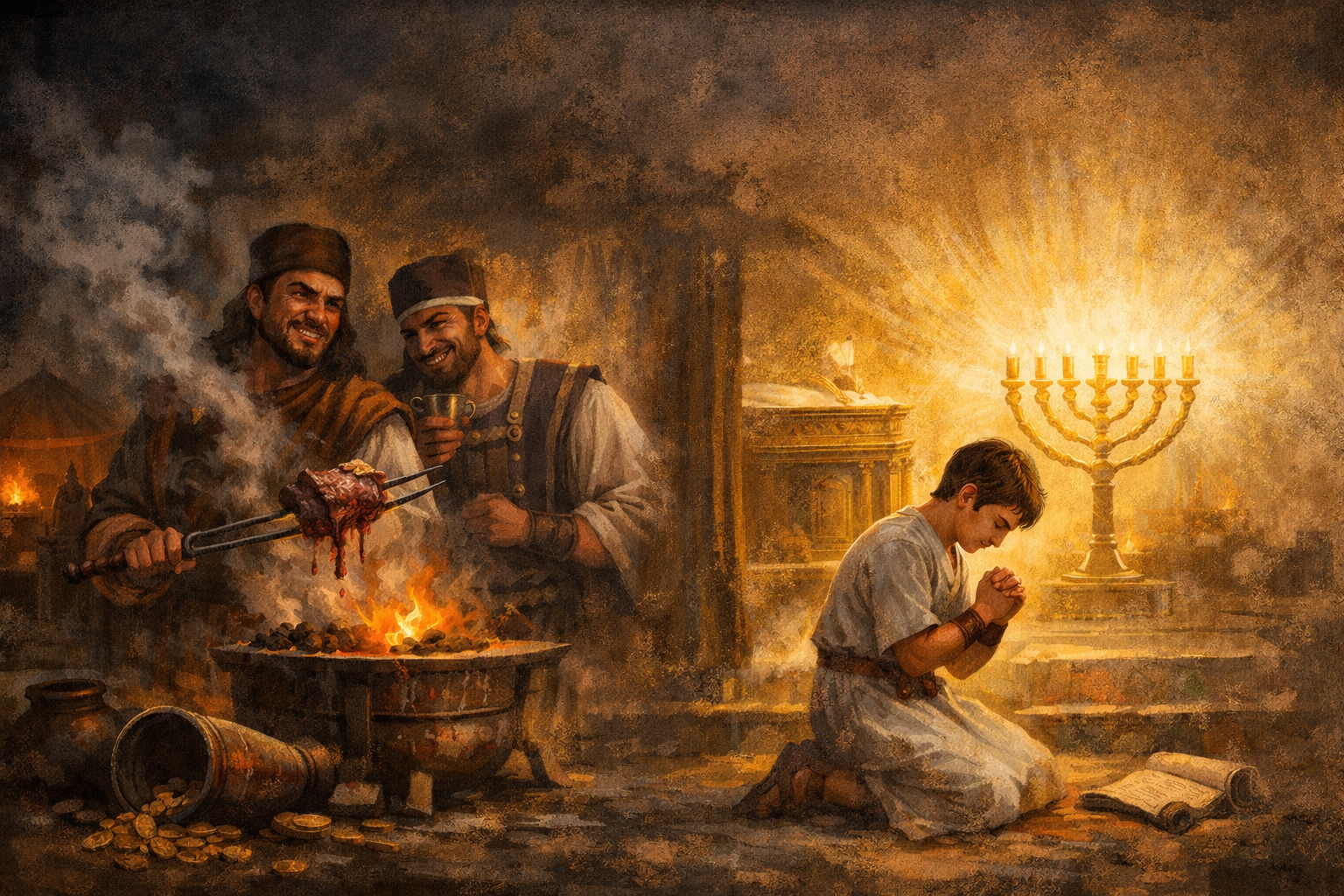
Life is often marked by stark contrasts. In 1 Samuel 2:11–36, we see one of the clearest contrasts in Scripture: the quiet, faithful ministry of young Samuel alongside the corrupt and scandalous behavior of Eli’s sons, Hophni and Phinehas. Though these priests were ordained to serve at the altar, they despised the Lord and abused His people. Yet in the midst of spiritual decay, God was still at work—raising up a faithful servant and promising a faithful priest. This passage reminds us that while human leaders may fail, the Lord never does.
1. Corrupt Priests Who Did Not Know the Lord
Hophni and Phinehas were priests—descendants of Aaron through Ithamar—set apart to minister before the Lord. They had the sacred privilege of offering sacrifices and representing the people before God (Exodus 28:1; Leviticus 9:7).
Yet Scripture gives a chilling assessment:
“Now the sons of Eli were worthless men. They did not know the LORD.” (1 Samuel 2:12, ESV)
Though ordained outwardly, they were spiritually empty inwardly. The word “worthless” echoes Hannah’s earlier statement (1 Samuel 1:16), highlighting the contrast between sincere devotion and hollow religion.
Their Sins Against the People
God had clearly prescribed how sacrifices were to be offered (Leviticus 3:3–5). The fat portions belonged first to the Lord. Only afterward would the priests and families partake in a sacred meal before Him.
But Hophni and Phinehas:
- Took more than their allotted portion.
- Demanded meat before the Lord’s portion was offered.
- Threatened worshipers who objected.
Verse 17 summarizes their sin:
“Thus the sin of the young men was very great in the sight of the LORD, for the men treated the offering of the LORD with contempt.”
They turned worship into exploitation. What was meant to be holy became selfish. What was meant to honor God became an opportunity for greed.
Their Sins Against the Lord
Their corruption went even further. They committed sexual immorality with the women serving at the entrance to the tent of meeting (1 Samuel 2:22). Those who were called to lead in holiness became instruments of defilement.
They were:
- Hedonists instead of shepherds.
- Bullies instead of servants.
- Profane instead of holy.
And though Eli rebuked them verbally (1 Samuel 2:23–25), he failed to remove them from ministry. Leadership negligence compounded the sin.
2. A Faithful Boy Growing in the Lord
Against this dark backdrop shines a simple but powerful refrain:
“Now the boy Samuel continued to grow both in stature and in favor with the LORD and also with man.” (1 Samuel 2:26)
While Eli’s sons grew distant from God, Samuel grew near. While they exploited worship, Samuel ministered in a linen ephod with reverence (1 Samuel 2:18).
This verse foreshadows another faithful Servant. Luke 2:52 echoes this language about Jesus:
“And Jesus increased in wisdom and in stature and in favor with God and man.”
Samuel points forward to Christ. In a time of corruption, God was quietly raising up a faithful servant.
This reminds us that God always preserves a remnant (Isaiah 1:9). Even in seasons of spiritual decline, the Lord is at work.
3. A Certain Judgment from a Holy God
A “man of God” brings a sobering message of judgment against Eli’s house (1 Samuel 2:27–34). Because they honored their sons above the Lord, judgment would fall. Their priestly line would be cut off.
God’s holiness will not be mocked (Galatians 6:7).
Judgment may seem delayed, but it is never denied.
Yet even in judgment, we see God’s faithfulness. His purposes will stand. Human failure cannot overturn divine sovereignty (Isaiah 46:9–10).
4. The Promise of a Faithful Priest
In verse 35, the Lord declares:
“And I will raise up for myself a faithful priest, who shall do according to what is in my heart and in my mind.”
Historically, this promise was partially fulfilled in faithful leaders like Samuel and later Zadok during David’s reign. But ultimately, it points beyond them to Jesus Christ—our Great High Priest.
Hebrews 7:26 tells us:
“For it was indeed fitting that we should have such a high priest, holy, innocent, unstained, separated from sinners, and exalted above the heavens.”
Where Hophni and Phinehas were corrupt, Christ is holy.
Where they exploited worship, Christ offered Himself as the perfect sacrifice (Hebrews 9:12).
Where they brought judgment, Christ bears judgment for His people.
God’s faithfulness is seen most clearly at the cross.
5. The Greatest Contrast of All
Isaiah 64:6 reminds us:
“All our righteous deeds are like a polluted garment.”
The contrast is not only between Samuel and Eli’s sons. It is ultimately between our sinfulness and God’s holiness.
How then can we stand before Him?
2 Corinthians 5:21 gives the answer:
“For our sake he made him to be sin who knew no sin, so that in him we might become the righteousness of God.”
Our only hope is not in better priests, better leaders, or even better behavior. Our hope is in Christ alone—salvation by grace through faith.
Application
- Do not place ultimate trust in human leaders. Only Christ is perfectly faithful (Psalm 146:3).
- Take sin seriously. God sees what others overlook.
- Remain faithful in small, unseen service. God honors quiet obedience.
- Rest in the finished work of Jesus, our Great High Priest.
Even when the church disappoints us, even when leaders fall, even when corruption seems widespread—God is still on His throne.
Closing Thought
The story of Hophni and Phinehas warns us of the danger of empty religion. The story of Samuel encourages us toward faithful devotion. But the promise of a faithful Priest points us to Jesus.
Have you trusted in Him?
Will you rest in His righteousness today?
Though men may fail, our God never does.

 beyond the sermon
Leave a comment