
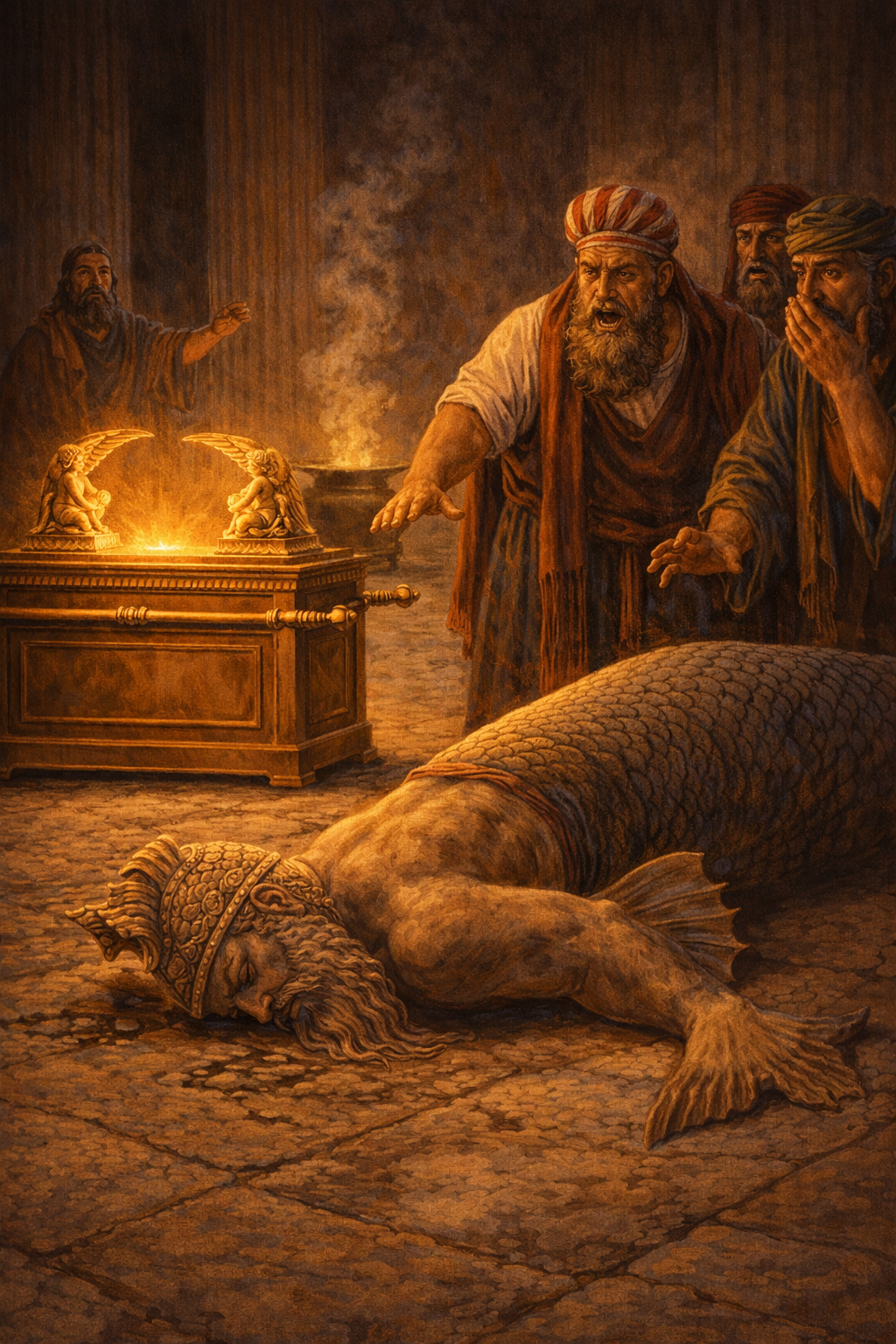
1 SAMUEL – God vs. Dagon
1 Samuel 5:1–12
Speaker – Matt Macleod
Main Idea
The Lord alone is God—He will not share His glory, and He must be approached with reverence, not treated lightly.
Summary
What looked like defeat at the end of chapter 4 was not the end of the story—it was only halftime. Though the Ark had been captured and the glory seemed gone, 1 Samuel 5 reveals that God had not lost. In fact, He was about to demonstrate His supremacy over false gods and His authority over all people.
1. God Will Not Be Treated as a Trophy (vv. 1–2)
The Philistines placed the Ark of God in the temple of Dagon as a spoil of war—either as tribute or as another “god” to add to their collection.
- The Ark represented God’s presence, holiness, and covenant.
- Israel had already reduced it to a tool or good luck charm.
- Now the Philistines treated it as a trophy.
Biblical Insight:
God is not an object to be used, managed, or displayed. He is the living God who dwells in holiness.
Application:
- Do we treat God as central—or as something we turn to only when needed?
- Worship must flow from who He is, not what He gives.
2. God Alone Is God (vv. 3–5)
Twice, Dagon falls before the Ark—first bowed, then broken.
“I am the Lord; that is my name; my glory I give to no other.” — Isaiah 42:8 (ESV)
- The first fall is a warning: Dagon bows before the Lord.
- The second fall is decisive: his head and hands are cut off—symbolizing total defeat.
Key Truth:
Every false god will fall before the one true God.
Application:
- What “idols” compete for God’s place in your life?
- God will not share His glory—with Dagon or with anything in us.
3. God Is Holy and Must Be Revered (vv. 6–12)
The hand of the Lord falls heavily on the Philistines—bringing affliction, fear, and death.
- The Ark moves from Ashdod → Gath → Ekron
- Everywhere it goes, judgment follows
- The Philistines pass it around instead of repenting
“Let us offer to God acceptable worship, with reverence and awe, for our God is a consuming fire.” — Hebrews 12:28–29 (ESV)
Key Truth:
God is patient—but He is also just. His holiness demands a right response.
Application:
- Are we casual or reverent in our approach to God?
- Do we repent—or do we try to pass off conviction and consequences?
4. God Defends His Own Glory
God did not need Israel to rescue Him—He defeated Dagon and judged the Philistines Himself.
Key Truth:
God is fully capable of defending His name, His holiness, and His glory.
Application:
- We do not “manage” God—He rules over us.
- Our role is not to control Him, but to submit to Him.
5. The Right Response: Reverence, Repentance, and Surrender
This chapter presses one central question: Who is the Lord to you?
Jesus asked a similar question in Matthew 16:15 — “Who do you say that I am?” (ESV)
- Israel knew God but treated Him casually
- The Philistines knew of God but did not submit to Him
- Both faced consequences
Practical Applications
1. Reject Casual Christianity
God is not a good luck charm or a Sunday-only priority.
2. Restore Reverence in Worship
Come before Him with awe, humility, and gratitude.
3. Repent Quickly
Do not pass conviction around—respond to it.
4. Remove Idols
Anything competing with God will ultimately fall.
5. Surrender Fully to Christ
Jesus bore judgment so we would not have to—trust Him, follow Him, and submit to Him as Lord.
Closing Thought
The Ark in Dagon’s temple looked like defeat—but it became a stage for God’s glory.
What appears to be loss is often where God is about to display His power.
The Lord is not to be taken lightly—He is holy, sovereign, and worthy of all worship.

 beyond the sermon
Leave a comment