
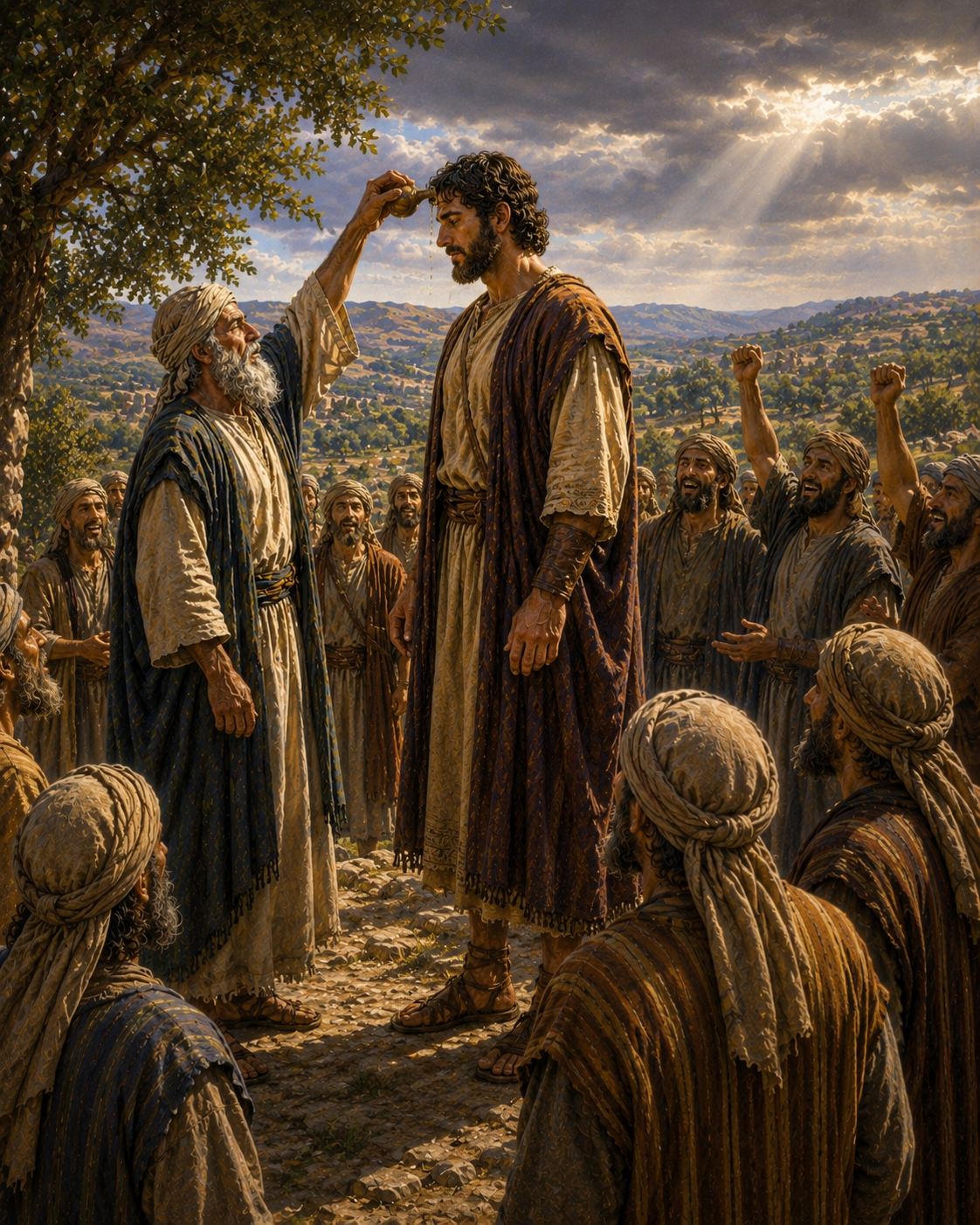
AFFIRMING THE ANOINTED
1 Samuel 10
Main Idea
Israel wanted a king who looked the part, but outward appearance could never provide the salvation they truly needed. Saul’s anointing points beyond human leadership to the only true King and Savior—Jesus Christ.
The Anointing of Saul (1 Samuel 10:1–8)
Samuel privately anoints Saul with oil and declares that the Lord has chosen him to lead His people. Saul is not presented as an independent ruler, but as a steward under God’s authority.
Leadership in Scripture is never primarily about power, status, or control. Every position entrusted by God—whether in the home, church, workplace, or community—is ultimately a stewardship. Even a king is called to serve under the authority of the true King.
Saul looked impressive on the outside:
- wealthy family
- handsome appearance
- taller than everyone else
Yet the chapter quietly reminds us that outward appearance and inward character are not the same thing. Israel wanted a visible king who matched the nations around them, but appearances can be deceptive.
God’s Power Is Given (1 Samuel 10:9–16)
God graciously equips Saul for the task before him:
- “God gave him another heart”
- “The Spirit of God rushed upon him”
God does not merely call people—He equips them. Saul needed more than appearance, talent, or charisma. He needed:
- a heart shaped for the work
- the empowering presence of God’s Spirit
The same remains true today. Skill, personality, influence, and image are never substitutes for spiritual surrender and dependence upon God.
The chapter also offers a sobering warning. Saul experienced:
- anointing
- fulfilled signs
- public affirmation
- spiritual empowerment
Yet later he would drift into disobedience and spiritual failure.
Spiritual experiences alone do not guarantee spiritual faithfulness. The Christian life is sustained not by isolated emotional moments, but by continual surrender and obedience to the Lord.
God’s Clear Warning (1 Samuel 10:17–25)
When Samuel gathers the nation, he reminds them of God’s faithfulness in delivering Israel repeatedly throughout their history. Yet despite God’s proven faithfulness, the people demanded a king “like all the nations.”
Their request revealed something deeper:
they were replacing their King.
They wanted something:
- visible
- immediate
- controllable
- culturally familiar
The same temptation exists today. People often place their confidence in:
- systems
- success
- stability
- politics
- personalities
- institutions
Rather than resting fully in God, we subtly replace Him with things we can see and manage.
The Question That Changes Everything (1 Samuel 10:26–27)
At the end of the chapter, some men support Saul while others reject him and ask:
“How can this man save us?”
Though spoken in skepticism, the question points to a deeper truth.
Saul could win battles, but he could not save Israel from its deepest problem—sin and the human heart. No earthly king, leader, or system can ultimately rescue humanity.
Israel did not merely need a king.
They needed a Savior.
Saul ultimately points forward to Jesus Christ:
- not a king exalted for outward appearance
- but a humble King
- not a disobedient ruler
- but the perfectly obedient Son
- not one who merely fought earthly enemies
- but One who conquered sin, death, and the grave
The question becomes:
“How can this man save us?”
Only if He is God in the flesh.
Only if He lived without sin.
Only if He died in our place.
Only if He rose again.
That is exactly who Jesus is.
Jesus Christ came not to save Himself, but to save sinners through the cross. As Acts 4:12 declares:
“And there is salvation in no one else, for there is no other name under heaven given among men by which we must be saved.”
Key Applications
- God values faithfulness more than image.
- Leadership is stewardship under God’s authority.
- Spiritual experiences must lead to ongoing obedience.
- Anything trusted more than God becomes a substitute king.
- Human leaders cannot save us; only Christ can.
Closing Challenge
Israel desired a king who looked impressive. But salvation would never come through Saul—or even David ultimately. Their deepest need could only be met by the true King.
The same is true today.
Many people still seek salvation in:
- success
- control
- comfort
- politics
- religion
- self-improvement
But there is only one King who truly saves.
Jesus Christ alone is “the way, and the truth, and the life” (John 14:6). The cross proves how this Man saves us—by giving Himself for sinners.


Leave a Reply