
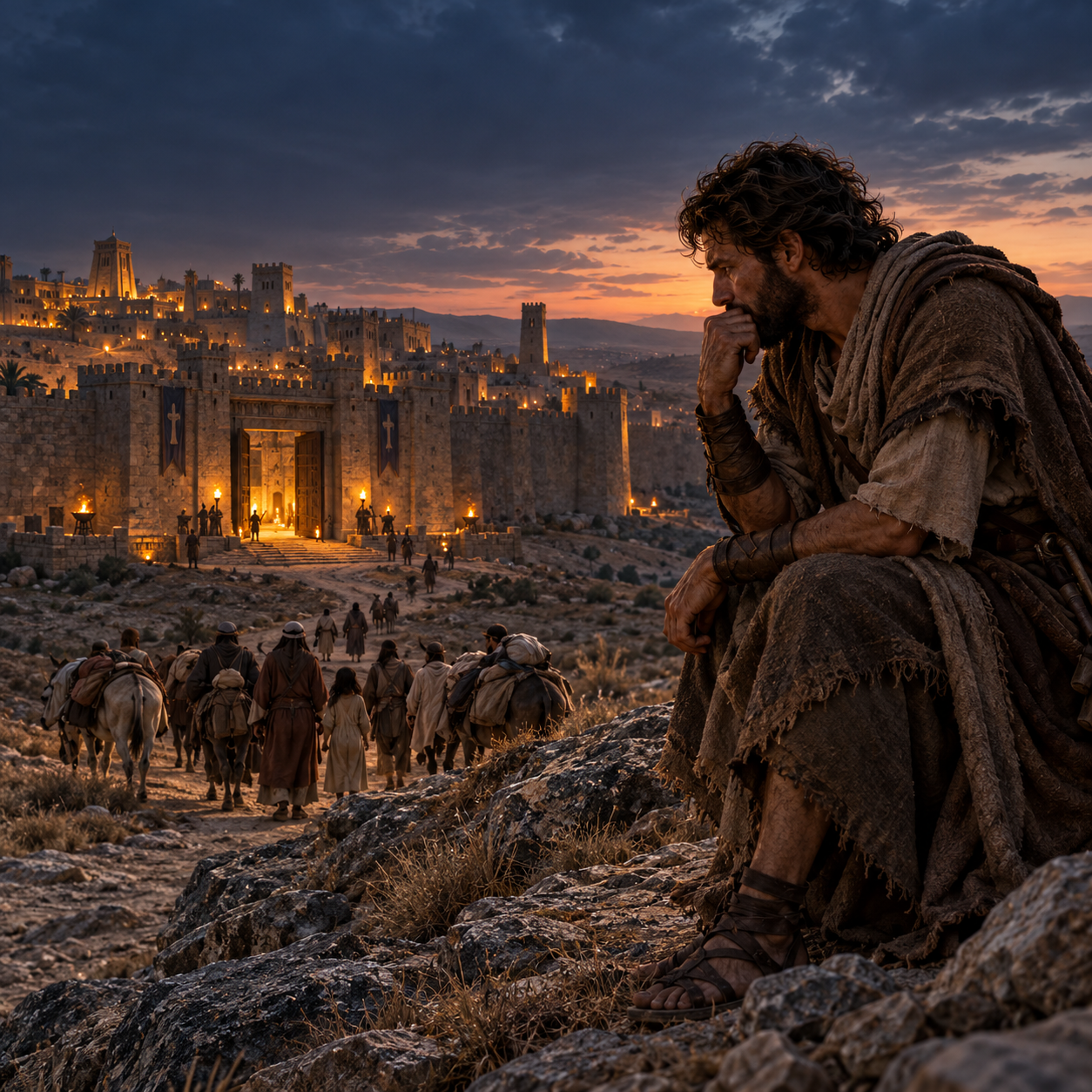
Where Fear and Despair Lead
1 Samuel 27:1–28:2
Main Truth
The issue is not whether we will face fear, but where we will go when we do.
Fear is a normal part of human life, and in some ways it can be helpful. But fear can also twist reality and control our lives. In 1 Samuel 27, prolonged pressure and weariness begin to affect David’s thinking, and instead of seeking the Lord, he begins relying upon his own plans.
Introduction
Throughout 1 Samuel, David has demonstrated remarkable courage. He faced Goliath, led Israel’s armies against the Philistines, and survived Saul’s relentless pursuit.
That makes the opening of chapter 27 so startling:
“Now I shall perish one day by th e hand of Saul.” (1 Samuel 27:1)
After repeatedly expressing confidence in the plans and purposes of God, David succumbs to the pressure of being on the run for so long. His fears have been amplified by his ongoing and seemingly endless circumstances.
David Said in His Heart
There is no indication that David sought the Lord for direction. We are not told that he called for Abiathar the priest or asked that the ephod be brought so he could determine the Lord’s will.
Instead, David looks inward: “David said in his heart…”
Like many of us, the trouble begins when we stop listening to God and choose to listen to our own hearts.
David listens to his heart, and it leads him to a place of fear and doubt—a place where his trust in the Lord is eroding and his circumstances seem overwhelming.
His heart tells him: “Now I shall perish one day by the hand of Saul.”
Nothing about God’s purpose for David had changed. But fear had begun to distort David’s view of reality.
David Goes to Gath
David’s heart gives in to despair, and he sees no other option than to return to Gath, the Philistine city and home of Goliath.
This is remarkable because David had been there before. In 1 Samuel 21, he had been forced to pretend to be insane just to escape alive.
Yet now David returns with his six hundred men and their families.
Eventually, Achish gives David the town of Ziklag, providing him with a secure place for his family and followers and a base of operations.
For the moment, David’s plan appears to work.
David’s Plan Works
David begins raiding the Geshurites, Gerzites, and Amalekites—longtime enemies of Israel.
When Achish asks about David’s activities, David answers carefully, making it sound as though he has been attacking Israelite territory rather than Israel’s enemies.
And the deception works.
- David is safe from Saul.
- He has a place for his family and his men.
- He has a base of operations from which to strike Israel’s enemies.
- He has tricked Achish into trusting him.
This goes on for nearly a year and a half.
Everything seems to be working.
Which raises the question:
What could possibly go wrong?
Now David Faces a Crisis
Achish gathers the Philistine forces to go to war against Israel and tells David that he and his men will go with them.
David’s deception has now created a serious problem.
Achish makes two demands:
- David will go with the Philistines to fight against Israel.
- David will become Achish’s personal bodyguard for life.
David has led Achish to believe that he is his ally and Israel’s enemy. So far that deception has worked to David’s advantage.
But now David faces a crisis.
What had seemed to provide safety has placed him in an increasingly dangerous position.
Fear Rarely Stops With Fear
What would bring such a bold man of faith to make decisions like these?
Fear rarely stops with fear.
Fear takes root in our:
- Anxiety
- Disappointments
- Stress
- Exhaustion
Fear can lead us to isolate ourselves from the Lord and from others.
Fear can move us away from relying on the Lord and toward relying on ourselves.
Fear can distort reality and lead us to believe lies.
The issue is not whether we will face fear. We will. And the circumstances of life can magnify that fear.
The issue is:
Where will we go when we are afraid?
David would declare in Psalm 56: “When I am afraid, I put my trust in you.” (Psalm 56:3)
But that is not what happens in 1 Samuel 27.
In his fear, David trusts in his own cunning and plans.
And to make matters worse, for a while it works.
Saul stops pursuing him.
Achish gives him Ziklag.
He defeats Israel’s enemies.
His deception succeeds.
He gains Achish’s trust.
But those successes only reinforce the direction he has chosen.
Application
Are you afraid?
Are you weary?
Are you tired of fighting the good fight only to wake up the next day and have to fight again?
Have you prayed for your circumstances to change, only to find that they remain the same?
In the midst of fear, your heart may tell you: “The Lord has obviously forgotten you. Make your plans. Do it your way. Trust yourself.”
But if we listen to God rather than our fears, we hear something very different:
“Trust in the LORD with all your heart, and do not lean on your own understanding. In all your ways acknowledge him, and he will make straight your paths.” (Proverbs 3:5–6)
Conclusion
David’s problem was not simply that he experienced fear. Fear is part of life. The problem was where David went with his fear.
Instead of seeking the Lord, he looked inward. Instead of relying on the Lord, he relied upon himself. Instead of trusting God’s purposes, he trusted his own plans. And although those plans appeared successful for a time, they eventually led him into a crisis of his own making.
The same choice faces us when fear and weariness begin to overwhelm us.
We can listen to our fears.
We can lean on our own understanding.
Or we can bring those fears to the Lord and trust His faithfulness.
Lay down your fears and lean into the faithfulness of the Lord.
Key Takeaway
The issue is not whether we will face fear, but where we will go when we do.


Leave a Reply