
When God Is Silent
1 Samuel 28:3–25
Saul’s problem was not that God had failed to speak. His problem was that Saul repeatedly refused to listen when God did speak.
God’s silence in 1 Samuel 28 comes after years of God’s speaking. Saul wants guidance from God without surrendering to God. He wants information from God without submission to God.
Introduction
Perhaps you have prayed:
“Lord, show me the way.”
“Lord, give me a sign.”
There is nothing wrong with asking God for guidance. But what if God has already spoken? What if He has already given us guidance? What if He has shown us the way, but we have not followed?
What if we simply do not like His answer?
That is Saul’s problem. He desperately wants to hear a word from the Lord even though he has blatantly rebelled against the Lord’s will for years.
The Lord Did Not Answer
The situation facing Saul is desperate. Samuel has died. The Philistines have gathered in force against Israel. Saul sees their army and becomes greatly afraid.
So Saul finally seeks a word from the Lord.
“And when Saul inquired of the LORD, the LORD did not answer him, either by dreams, or by Urim, or by prophets.”
— 1 Samuel 28:6
Saul wants God to speak. But God has been speaking to Saul for years. Through Samuel, God had repeatedly given Saul His word, His commands, His warnings, and His judgment. Saul repeatedly chose not to listen.
Now, when Saul desperately wants another word from God, the Lord does not answer.
Saul Seeks a Medium
When the normal means of hearing from the Lord fail, Saul chooses an ungodly and forbidden means to get what he wants.
“Seek out for me a woman who is a medium, that I may go to her and inquire of her.” — 1 Samuel 28:7
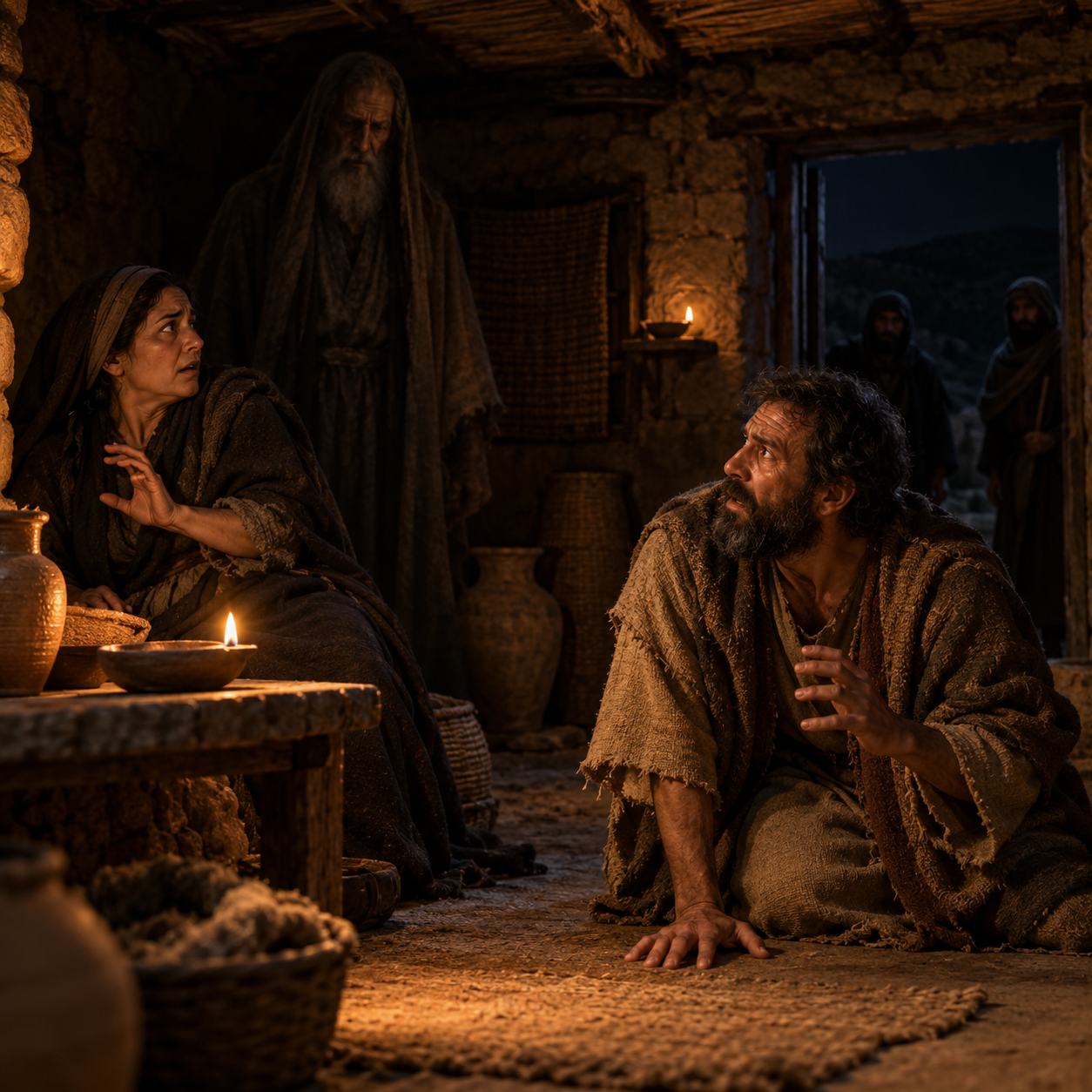
Saul disguises himself and travels by night to a medium at Endor. The setting reflects Saul’s spiritual condition: disguised and in the darkness.
What makes Saul’s actions especially striking is that he himself had previously banned mediums and necromancers from the land. Now he asks the woman to do something forbidden both by the Lord and by Saul’s own decree. Even more ironically, Saul swears to her “by the LORD” while asking her to do something expressly forbidden by the Lord.
Saul has reached the point where desperation is driving him even deeper into disobedience.
“Bring Up Samuel for Me”
Saul asks the woman to bring up Samuel. When Samuel appears, the woman reacts with shock. She apparently experiences something she did not expect.
The passage presents this as Samuel himself. The medium does not appear to summon Samuel through her own power. Rather, God sovereignly sends Samuel with one final word for Saul.
Saul explains his desperation:
“I am in great distress, for the Philistines are warring against me, and God has turned away from me and answers me no more.”
Then comes Saul’s plea:
“Tell me what I shall do.”
But Saul is not seeking repentance and restoration. He is looking for a way out of his trouble.
One Final Word of Judgment
What Saul receives from Samuel is not what he wants. Samuel reminds Saul that the Lord’s verdict has not changed.
“Because you did not obey the voice of the LORD… therefore the LORD has done this thing to you this day.” — 1 Samuel 28:18
Saul is exactly where his own willful decisions have brought him. Samuel then completes the picture of Saul’s judgment:
- David will receive the kingdom.
- Israel will be defeated by the Philistines.
- Saul and his sons will die.
The finality of the message devastates Saul. He falls full length on the ground, overcome with fear and without strength.
Saul Goes Back Into the Darkness
The woman persuades Saul to eat before leaving. She prepares a meal fit for a king, but the setting is deeply ironic. Saul, the king of Israel, sits in the house of a pagan medium in the waning hours of his kingship. He is, in effect, a condemned man eating his last meal.
After eating, Saul and his servants rise and leave. The passage ends simply:
“Then they rose and went away that night.”
Saul walks back into the darkness—a fitting picture of his spiritual, emotional, and physical condition.
God’s Silence Came After Years of God’s Speaking
This is the heart of the passage.
Saul’s problem throughout his reign was not that God failed to speak. Saul repeatedly refused to listen when God did speak.
God’s silence in chapter 28 comes after years of God’s speaking.
Saul wants: GUIDANCE without SURRENDER.
He wants: INFORMATION without SUBMISSION.
First Chronicles explains Saul’s downfall:
“So Saul died for his breach of faith. He broke faith with the LORD in that he did not keep the command of the LORD, and also consulted a medium, seeking guidance. He did not seek guidance from the LORD.” — 1 Chronicles 10:13–14
Saul wanted God to tell him what to do even though he had spent years refusing to do what God had already told him.
Application
Perhaps the question for us is not simply:
“Is God speaking?”
A better question may be:
“Am I listening to what God has already said?”
The tragedy of Saul is not that God never spoke.
God spoke again and again. Saul simply refused to listen.
Zechariah records the sobering words of the Lord:
“As I called, and they would not hear, so they called, and I would not hear.”
— Zechariah 7:13
Not every experience of God’s silence is like Saul’s. Faithful men and women sometimes wait on God for years without receiving the answer they desire.
But Saul’s silence is different.
This is the silence that follows years of rejecting what God has said.
There is danger when we willingly live outside God’s will, neglect His Word and His church, pray only when we need Him to bail us out, and otherwise live as though He is irrelevant.
Conclusion
The answer is not merely to ask God for more information. The answer is to hear Him and respond.
Isaiah calls us:
“Seek the LORD while he may be found;
call upon him while he is near;
let the wicked forsake his way,
and the unrighteous man his thoughts;
let him return to the LORD, that he may have compassion on him,
and to our God, for he will abundantly pardon.” — Isaiah 55:6–7
Let our ears be attentive to His voice, our hearts responsive to His presence, and our feet ready to follow. Let us not close our ears, harden our hearts, or insist that the Lord meet us on our terms.
Saul’s desperate prayer was essentially: “Tell me what to do!”
He was looking for a way out, not a way back to God.
May our prayer instead be:
“Show me the way I should go, for to you I entrust my life.”
— Psalm 143:8
Key Takeaway
The question is not simply, “Is God speaking?” The better question is, “Am I listening to what God has already said?”


Leave a Reply