
Characteristics of a King
1 Samuel 30
Main Truth
1 Samuel 30 gives us a window into the kind of leader David was becoming and the kind of king he could be.
David reaches one of the lowest moments of his life. His plans have collapsed, his family has been taken, and even his own men have turned against him. Yet this crisis becomes a tipping point. Instead of continuing to rely on his own wisdom and cunning, David turns back to the Lord.
In doing so, David begins to display qualities of a godly king—but even David, a man after God’s own heart, points us beyond himself to the perfect King: Jesus.
Introduction
Earlier in 1 Samuel, the people of Israel demanded: “Give us a king!”
“Give us a king!”
They received Saul—a man who looked like a king but ultimately became exactly the kind of ruler Samuel had warned them about.
Then God sent Samuel to Bethlehem to anoint David. The question became: Would David simply become another Saul, or would he truly be a king after God’s own heart?
First Samuel 30 gives us an important window into the kind of man David was becoming and the kind of king he would be.
David Strengthens Himself in the Lord
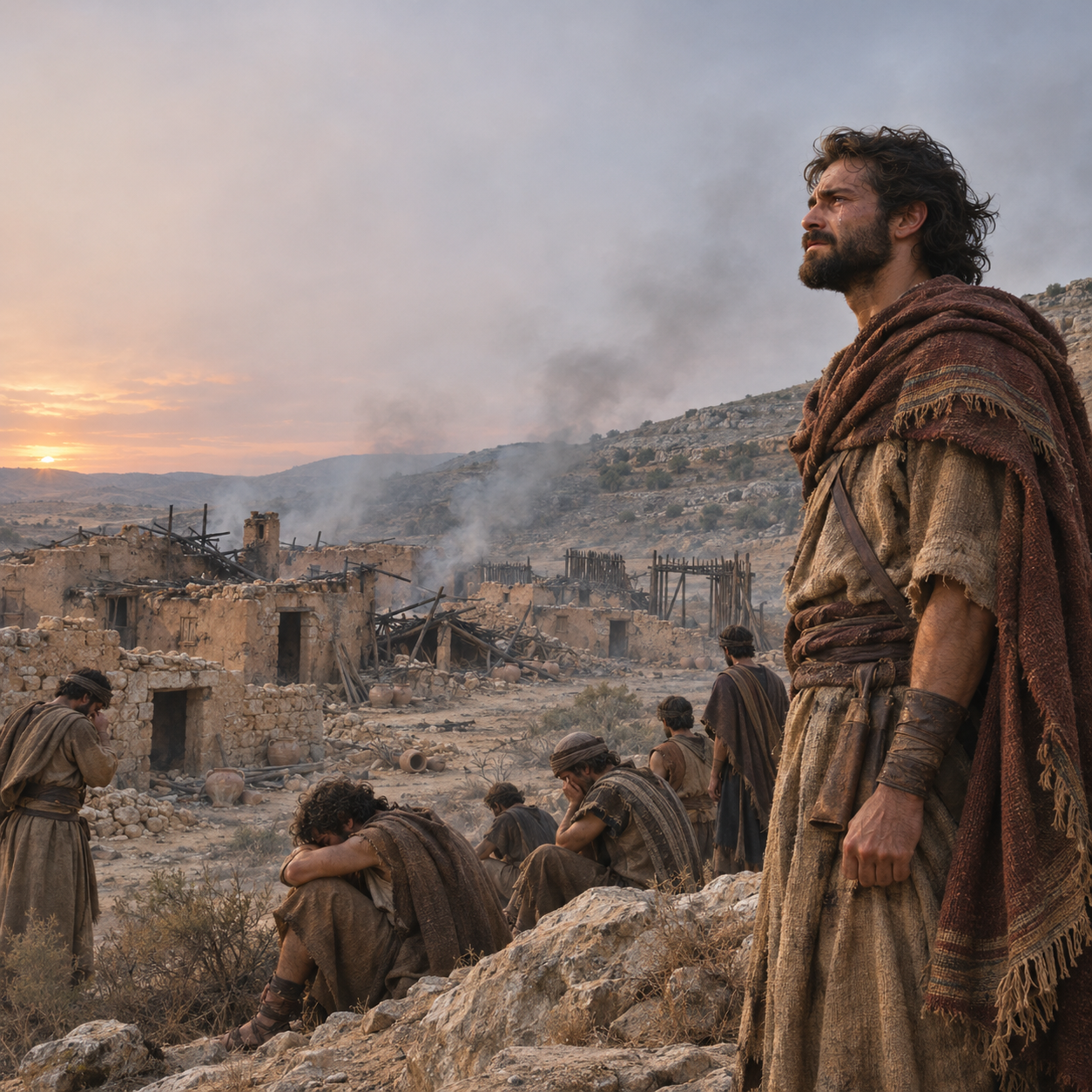
David returns to Ziklag to find the city burned and the families of his men taken captive by the Amalekites. The devastation is overwhelming. David and his men: “raised their voices and wept until they had no more strength to weep.” — 1 Samuel 30:4
Then the situation becomes even worse. David’s own men, bitter over the loss of their families, begin talking about stoning him.
David is greatly distressed. But then comes the turning point: “But David strengthened himself in the LORD his God.” — 1 Samuel 30:6
For some time, David’s pattern had increasingly been to rely upon his wits, skill, and cunning. Now his house of cards has collapsed. David has nowhere else to turn. And finally, he turns to the Lord.
A crisis like this can lead us deeper into despair—or it can drive us to the throne of God.
David Seeks God’s Direction
David calls for Abiathar the priest and asks for the ephod. Then David asks the Lord: “Shall I pursue after this band? Shall I overtake them?”
The Lord answers: “Pursue, for you shall surely overtake and shall surely rescue.”
David had been making many decisions on his own, but now he seeks the Lord’s direction. And one of the striking things about this moment is that David could have done this all along.
The same is true for us. We do not have to wait until everything falls apart before seeking the Lord’s direction.
David Obeys Decisively
Once God speaks, David acts. He does not simply receive God’s direction and then continue debating what he should do.
David acts on the answer the Lord provides. David and his men immediately begin pursuing the Amalekites.
The principle is simple:
When the Lord reveals His will to us, we would be wise to act on it.
It is not enough merely to hear the Word of God. Faithful obedience means doing what God says.
David Leads Through Suffering
David’s suffering in this chapter is real. His plans have turned to ashes. His family has been taken captive. Some of his own men have turned against him.
David is deeply wounded. Yet in the Lord’s strength and with the Lord’s guidance, David continues leading the people entrusted to him.
There is an important reality here:
Every godly leader is a wounded leader.
Leadership does not mean living without pain, disappointment, betrayal, or exhaustion.
David does not wait until all of his own wounds are healed before caring for the people God has placed under his leadership. He leads while hurting—but he does so now in the strength of the Lord.
David Cares for the Weak
As David pursues the Amalekites, two hundred of his six hundred men become too exhausted to continue. They remain behind at the brook Besor while the other four hundred continue the pursuit.
After the victory, some of David’s men argue that those who stayed behind should receive nothing except their wives and children. David refuses. “As his share is who goes down into the battle, so shall his share be who stays by the baggage. They shall share alike.” — 1 Samuel 30:24
David does not exclude the weak. The two hundred could not do everything the others did, but they did what they could. David recognizes that their limitations do not make them worthless.
That provides a helpful picture for the church as well. God’s people serve in different ways, with different gifts, strengths, opportunities, and limitations. There is a place for each one.
David Shows Wisdom and Mercy
Along the way, David’s men discover an Egyptian servant who has been abandoned by his Amalekite master because he became sick.
It would have been easy to ignore him. They were in a hurry. He appeared insignificant. He had been associated with the very people who had destroyed Ziklag. But David shows him mercy.
They give him food and water and care for him until his strength returns. David also recognizes that this man may be able to help them. The abandoned servant becomes the key to locating the Amalekite camp.
David demonstrates both mercy and wisdom. The man others might have considered worthless becomes the very person God uses to show them the way.
David Acts to Deliver His People
The Egyptian leads David directly to the Amalekite camp. David attacks and defeats them. The result is complete deliverance: “David recovered all that the Amalekites had taken.” — 1 Samuel 30:18
Nothing is missing. The wives are rescued. The children are rescued. Their possessions are recovered. David does what a king should do: He acts to deliver his people.
David Recognizes Victory as God’s Gift
After the victory, David does not take the credit. He tells his men: “You shall not do so, my brothers, with what the LORD has given us. He has preserved us and given into our hand the band that came against us.” — 1 Samuel 30:23
David recognizes that the victory belongs to God. The Lord had:
- Confirmed the plan and promised victory.
- Kept their families safe during their captivity.
- Provided the Egyptian servant to guide them.
- Brought them to the Amalekite camp at the right moment.
David had once told Goliath: “The battle is the LORD’s.” Now he is living as though he believes it again.
“The battle is the LORD’s.”
David Shares Generously
David does not use the victory simply to enrich himself. First, he ensures that the two hundred men who remained behind receive an equal share. Then he sends portions of the spoil to the elders and communities of Judah that had previously helped David and his men while they were fugitives.
David remembers those who had helped him. He responds with gratitude and generosity. Because David understands that everything ultimately came from God, he can hold loosely what other men might clutch tightly.
Application
There are leadership lessons throughout this chapter for our homes, workplaces, churches, and communities.
David shows us the importance of:
- Finding our strength in the Lord.
- Seeking God’s direction.
- Responding with decisive obedience.
- Continuing to lead even through personal suffering.
- Caring for those who are weak and exhausted.
- Showing wisdom and mercy.
- Acting for the good of the people entrusted to us.
- Recognizing that every victory is ultimately God’s gift.
- Holding God’s blessings loosely enough to share generously.
But we should look beyond merely practical leadership lessons. We should even look beyond the contrast between Saul and David.
Conclusion
At the beginning of 1 Samuel, Israel cried: “Give us a king!”
“Give us a king!”
God gave them Saul. Saul was willful and rebellious.
Then God gave them David. David was better. He was called “a man after God’s own heart,” but David still had feet of clay.
God’s final answer to the cry for a king was not Saul. It was not ultimately David. God gave us a King who came from the throne room of heaven itself – King Jesus.
Jesus came not merely to give us principles for living a better life.
He came to reveal God’s heart and God’s plan to save us.
He came to teach the truth.
He came to live the sinless life we could never live.
He came to die for our sins on the cross, paying the price for us.
He rose again on the third day to give life to those who trust Him.
He came to bring true light into our darkness and true life into our spiritual death.
Perhaps you identify with David at Ziklag: “I can’t do this anymore.”
“I can’t do this anymore.”Then step out of the rubble of your life and place your trust in Jesus.
God’s Word calls us to repent and believe.
Repent of your sin and selfishness.
Acknowledge that you cannot save yourself.
Believe in Jesus and trust His finished work alone for salvation.
God, in His grace and mercy, has given us a King.
Will we bend our knees and our hearts to Him?
Key Takeaway
David gives us a glimpse of what a godly king should be, but Jesus is God’s final and perfect King—the One who strengthens, leads, cares for, delivers, and saves His people.


Leave a Reply