
The Death of a King and a Dream
1 Samuel 31
Main Truth
Saul’s life was a tragedy, but it was a tragedy that did not have to be.
Saul began with enormous promise. He had every outward quality Israel wanted in a king, and God gave him a clear mission. Yet one willful decision after another moved Saul farther from the will and heart of God.
His story reminds us that the choices we make today shape the person we become tomorrow. But Saul’s tragic end also points us to our need for something deeper than self-improvement. We need God to make us new.
Introduction
First Samuel has taken us on a long journey.
We have heard Hannah’s prayer.
We have celebrated the birth of Samuel.
We have witnessed the tragic end of Eli.
And we have watched the anointing of two kings, one on the way down and another on the difficult path upward.
Now the book that began with such promise lands with a thud. The final chapter brings us to the end of Saul’s reign and the tragic consequences of a life increasingly lived apart from the Lord.
Saul’s Fear Comes Full Circle
The Philistines gather against Israel, and the Israelite army flees before them. This should not surprise us. Earlier, when Saul saw the Philistine army:
“he was afraid, and his heart trembled greatly.” (1 Samuel 28:5)
Fear was a constant undercurrent in Saul’s life.
Over time, that fear contributed to Saul becoming a rebellious, willful, and treacherous king. He increasingly shut the Lord out. He refused to listen when God spoke. He refused to follow when God led.
There is a sobering warning here: We need to be very careful when we push the Lord out of our lives, close the door in His face, and refuse to listen when He speaks.
We need to be very careful when we push the Lord out of our lives, close the door in His face, and refuse to listen when He speaks.
Saul had repeatedly refused to hear the Lord. Eventually, the Lord stopped answering.
Saul and His Sons Fall on Mount Gilboa
The Philistines overtake Saul and his sons. Jonathan, Abinadab, and Malchi-shua are killed. Then the battle closes in around Saul. The archers find him and badly wound him.
Fearing what the Philistines will do if they capture him alive, Saul asks his armor-bearer to kill him. When the armor-bearer refuses, Saul falls on his own sword.
The chapter gives the devastating summary:
“Thus Saul died, and his three sons, and his armor-bearer, and all his men, on the same day together.” (1 Samuel 31:6)
Israel’s defeat extends beyond the battlefield. The people abandon their cities, and the Philistines move in and occupy them. The king who had been called to deliver Israel from the Philistines dies as the Philistines expand their control over Israel’s land.
Saul’s Story Began With So Much Promise
Saul’s ending is especially tragic because his story began with such promise. When we first met Saul, he was described as: “a handsome young man. There was not a man among the people of Israel more handsome than he. From his shoulders upward he was taller than any of the people.” (1 Samuel 9:2)
He was tall, handsome, from a wealthy family. In short, he was impressive. Saul had all the potential in the world.
And God gave him a mission: “He shall save my people from the hand of the Philistines.” (1 Samuel 9:16)
Yet Saul’s story begins with great promise and ends with death and destruction.
The Philistines are not driven back. They control even more of the Promised Land. Israel is afraid and on the run. And Saul … he is dead.
From Coronation to Cremation
The day after the battle, the Philistines return to strip the bodies of the dead. They find Saul and cut off his head. His head is placed in the temple of Dagon, and his armor is placed in the temple of Ashteroth. To the Philistines, these acts declared that their gods had triumphed over Saul, Israel, and Israel’s God.
Then Saul’s headless body and the bodies of his sons are fastened to the wall of Beth-shean. It is intended to demean Saul, dishearten Israel, and broadcast the Philistine victory.
The contrast could hardly be greater. Saul had begun as the tall, handsome, celebrated first king of Israel. Now his body hangs on the wall of an enemy city.
The things that took Saul from coronation to cremation were not one spectacular act of rebellion. It happened through one choice after another choice after another.
The very things that moved Saul away from the Lord are the same things that can push us away from His presence.
The Men of Jabesh-Gilead Remember
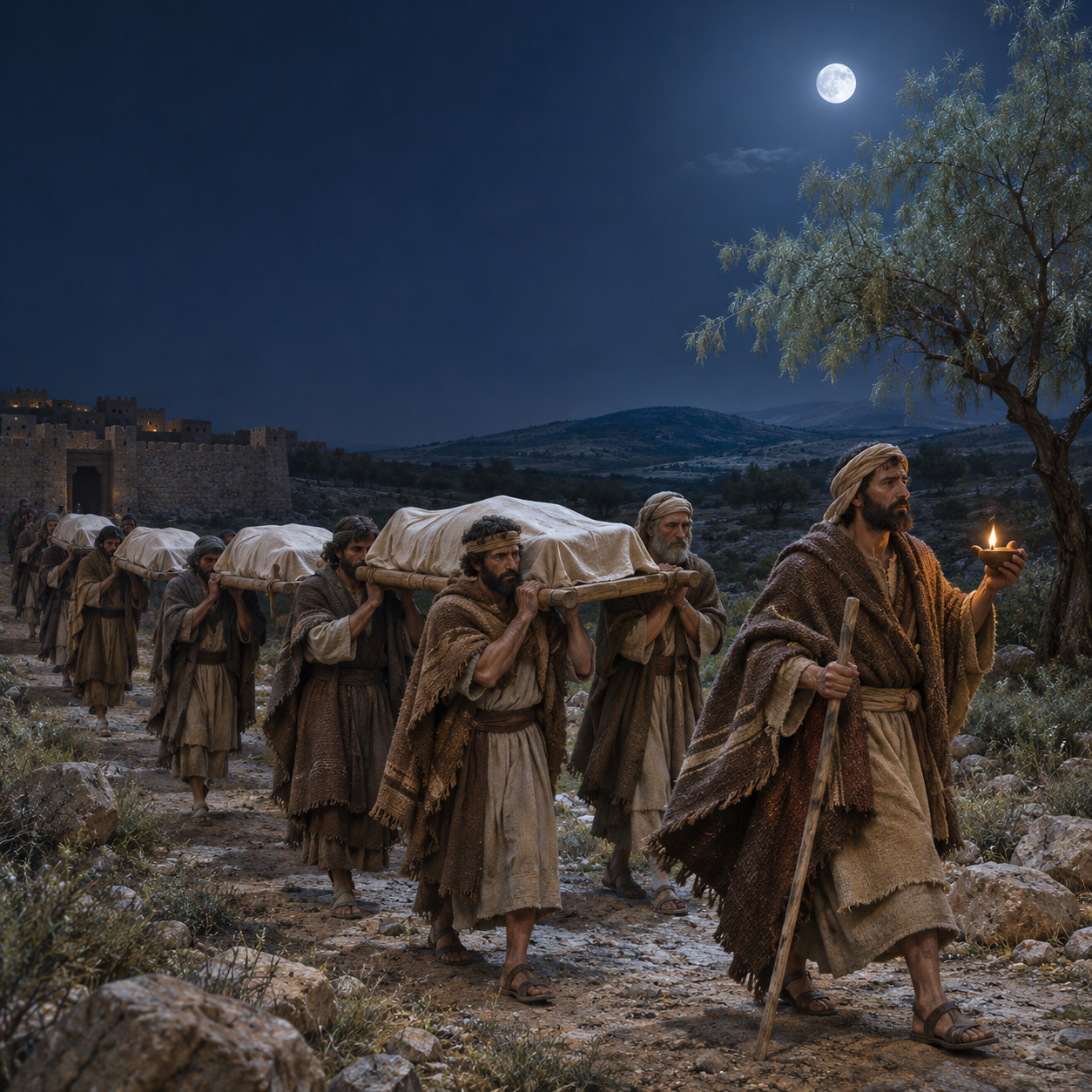
The chapter contains one final act of courage and dignity. When the men of Jabesh-gilead hear what has happened, they travel through the night to Beth-shean, remove the bodies of Saul and his sons, and bring them home for burial.
Why would they take such a risk? Because they remembered. Years earlier, in 1 Samuel 11, Saul had rallied Israel to rescue Jabesh-gilead from the Ammonites.
Now, at the end of Saul’s life, those men honor the king who had once rescued them. They cannot change Saul’s story, but they can ensure that his final remains are treated with dignity.
A Tragedy That Did Not Have to Be
We prefer stories with happy endings. First Samuel does not give us one for Saul.
Saul’s life was a tragedy, but it was a tragedy that did not have to be. One willful decision after another took Saul farther from the will and heart of God.
We may think we would have done differently. We tell ourselves that we would remain faithful. We would keep our hearts open. We would listen to the Lord.
But then come fear, pride, jealousy, self-will, disappointment, and desperation. Each time we choose according to those things instead of trusting the Lord, it becomes easier to make the same choice again.
The Lord’s knock on the door of our hearts can seem more faint. Our hearts become more calloused.
And Saul is not the only warning. Even David, the man after God’s own heart, sometimes allowed fear and desperation to turn him inward so that he relied on his own cunning and ability instead of the Lord.
David was not immune, and neither are we.
Application
So what do we do?
No matter how far you have fallen, no matter how much fear, pride, jealousy, or self-will has shaped your life, today can be the day you cry out to God: “I don’t want to remain caught in a trap of my own making. I want to be free. I want to be whole. Lord, I am not asking You simply to make me a better person. Make me new.”
That is the hope of the gospel. In Christ, we have died with Him, and He now lives in and through us. We have been made new so that we might live new.
So we ask the Spirit of God to search the depths of our hearts. We ask Him to reveal what we have hidden in the dark corners of our lives. We pray with David for God to create in us a clean heart and renew a right spirit within us. We ask Him to be the Refiner’s fire, burning away the dross until our lives increasingly reflect His beauty, majesty, and glory.
Conclusion
Saul’s story ends in tragedy. A man who began with promise ended broken on Mount Gilboa. But Saul’s failure is not the final word for us.
Our hope is not found in trying harder to avoid becoming like Saul. Our hope is in the faithfulness and transforming grace of God.
“If we are faithless, he remains faithful.”
(2 Timothy 2:13)
The question is not simply whether we can make better choices. The deeper question is whether we will open our lives fully to the God who can make us new.
Do not allow another choice motivated by fear, pride, self-will, jealousy, or desperation to move you farther from the Lord.
Ask Him to search you, to cleanse you, to renew you. And trust the faithful God who remains faithful even when we are faithless.
Key Takeaway
Saul’s tragedy was built one choice at a time. Do not merely ask God to make you better. Ask Him to make you new.


Leave a Reply