
A Refuge and a Reprobate
1 Samuel 22
Main Truth
God is raising up His anointed king as a refuge for the desperate, while Saul’s rejection of God is driving him deeper into darkness.
1 Samuel 22 pictures two men moving in opposite directions. Saul still possesses the throne, but he is descending into paranoia, hatred, and godlessness. David has only a cave, but God is preparing him to be king.
1. David Becomes a Refuge for the Desperate — vv. 1–5
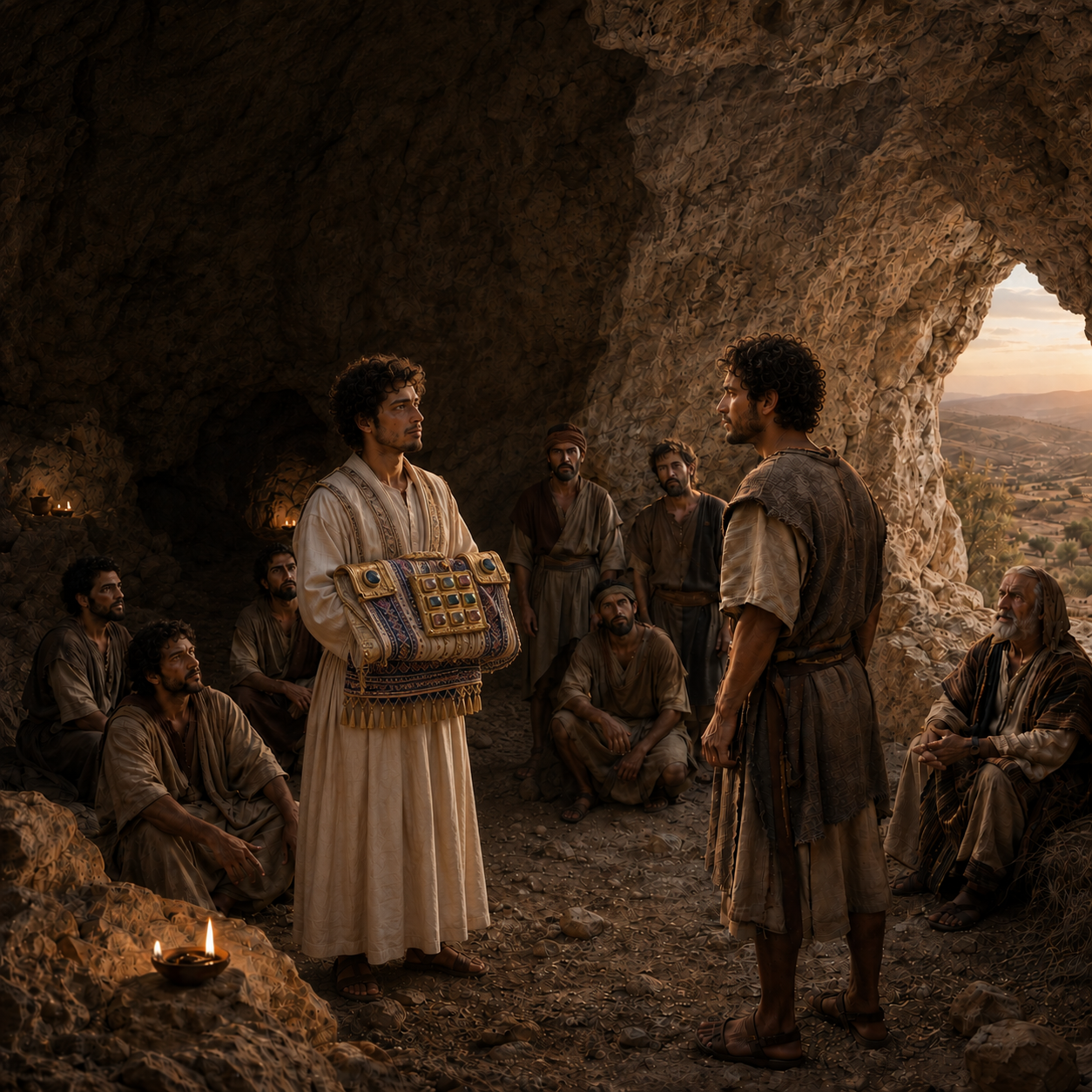
David escapes to the cave of Adullam, where his family and about four hundred men gather around him.
- They are described as distressed, in debt, and bitter in soul.
- David becomes their leader and protector.
- He cares for his family by taking his parents to Moab.
- When God directs him through Gad, David leaves the security of Moab and returns to Judah.
David has little outwardly, but God is forming a kingdom around His anointed king.
2. Saul Descends Deeper into Darkness — vv. 6–19
While David is gathering the desperate, Saul is becoming increasingly consumed by himself.
- Saul sees himself as the victim of a conspiracy.
- Doeg gives Saul information that is technically true but stripped of its context—truth weaponized for personal advantage.
- Ahimelech faithfully explains his innocence, but Saul refuses to listen.
- Saul orders the slaughter of the priests of the Lord.
- When his own servants refuse, Doeg kills eighty-five priests and destroys Nob.
The contrast with 1 Samuel 15 is striking: Saul would not destroy what God condemned, but now he destroys those who belong to God.
3. David Offers Refuge — vv. 20–23
Abiathar escapes the massacre and comes to David.
- David acknowledges his own part in placing the priests in danger.
- Unlike Saul, who continually blames others, David accepts responsibility.
- He tells Abiathar, “Stay with me; do not be afraid.”
David is beginning to look like the kind of king God intends him to be.
Application
- Guard against Saul’s downward path. Envy, bitterness, self-pity, and refusal to accept responsibility can lead farther than we imagine.
- Handle truth carefully. Facts without context can become weapons rather than instruments of grace.
- Accept responsibility for your own choices. Spiritual maturity does not require pretending we are innocent when we have contributed to harm.
- Run to the true King for refuge. Like those who gathered around David, we come to Jesus with burdens we cannot carry and a debt we cannot repay.
Conclusion
Saul has the throne, but he is going down. David has only a cave, but God is raising him up.
And David points beyond himself to the greater Son of David. Jesus welcomes the weary and burdened: “Come to me, all who labor and are heavy laden, and I will give you rest” (Matthew 11:28). His promise is even greater than David’s words to Abiathar: “Whoever comes to me I will never cast out” (John 6:37).
Key Takeaway
When everything around us seems uncertain, the safest place is with God’s King.


Leave a comment