
A Contrast of Hearts and Actions
1 Samuel 14:24–52
Main Idea
What fills the heart will eventually come out in our words, decisions, and actions—so we must surrender our hearts fully to the true King, Jesus Christ.
Overview
In 1 Samuel 14, Israel is in the middle of a major conflict with the Philistines. Earlier, Saul had already shown a pattern of impatience and self-reliance by offering a sacrifice he had no right to offer instead of waiting for Samuel. Because of this, Samuel declared that Saul’s kingdom would not endure. Against that backdrop, Jonathan steps forward in faith, trusting that “nothing can hinder the LORD from saving by many or by few” (1 Samuel 14:6). God gives Israel a remarkable victory, but Saul’s rash and self-focused leadership nearly turns that victory into tragedy. This passage gives us a clear contrast between two hearts: Jonathan’s heart of faith and Saul’s heart of pride.
1. Saul’s Rash Vow Revealed His Heart
Saul placed the army under a harsh oath: “Cursed be the man who eats food until it is evening and I am avenged on my enemies” (1 Samuel 14:24). His words reveal the condition of his heart. He did not speak of the Lord’s glory or the Lord’s victory. He spoke of his own revenge and reputation.
Fasting can be a godly act of dependence on the Lord, but Saul’s vow was not commanded by God, not sought through prayer, and not rooted in humble faith. It was a fleshly attempt to make himself look spiritual while relying on human effort.
Instead of strengthening the army, Saul weakened them. The people became faint, exhausted, and less effective in the battle. What God was graciously doing among His people, Saul hindered through foolish leadership.
Scripture Connections:
Proverbs 16:18 reminds us that “pride goes before destruction.” James 4:6 teaches that “God opposes the proud but gives grace to the humble.” Saul’s pride was not a small private flaw; it affected the whole nation.
2. Jonathan and Saul Show Two Very Different Hearts
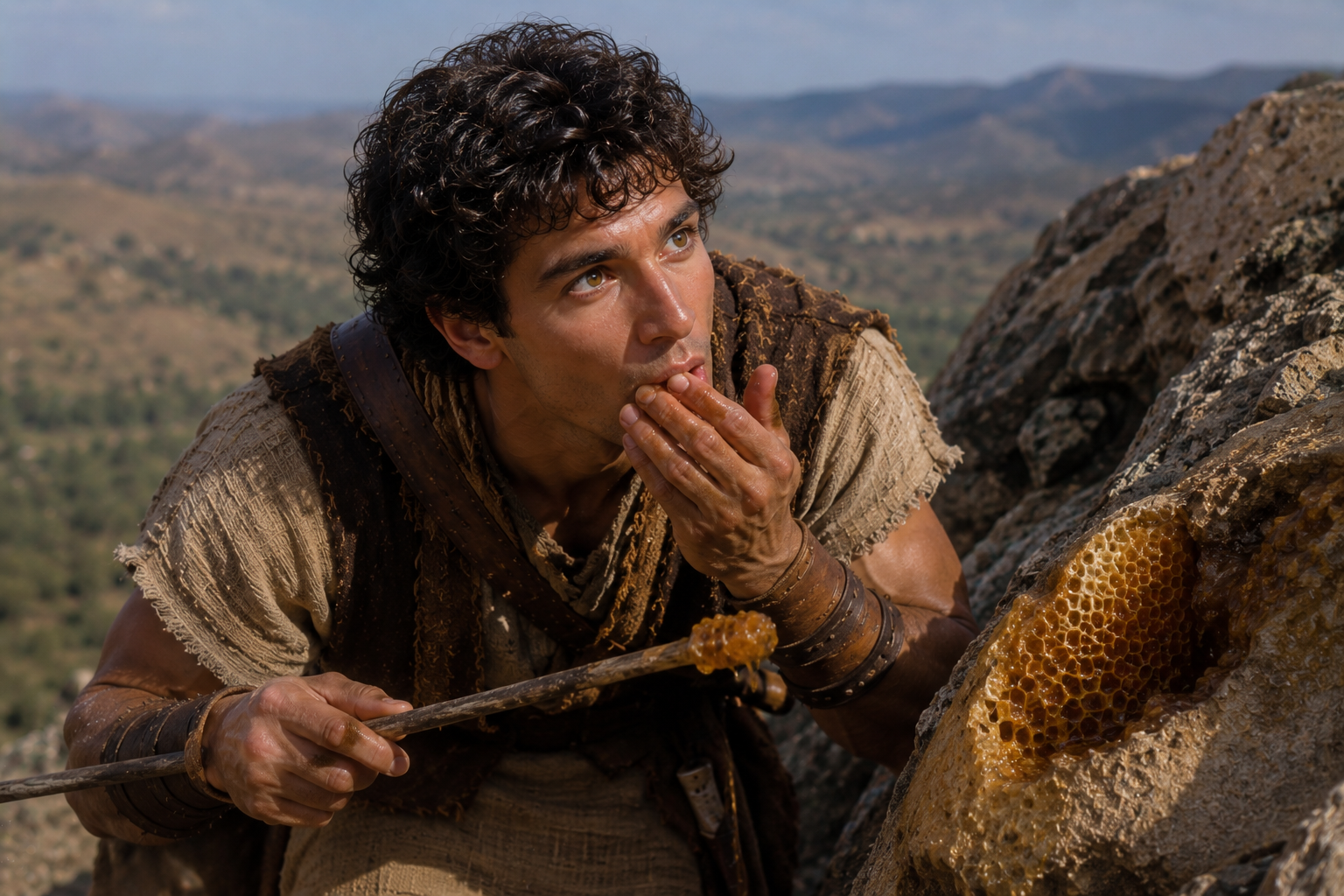
Jonathan unknowingly ate honey and was strengthened. His action stands in sharp contrast to Saul’s foolish command. Jonathan had acted by faith, trusting the power of God. Saul acted impulsively, trusting his own decree.
Jonathan strengthened the people, while Saul burdened them. Jonathan looked to the Lord, while Saul looked to himself. Jonathan rightly said, “My father has troubled the land” (1 Samuel 14:29). That statement captures Saul’s failure as a leader. The greatest obstacle to Israel that day was not the Philistine army but Saul’s prideful leadership.
Jonathan’s faith blessed others. Saul’s fleshly self-focus burdened others.
Scripture Connections:
Hebrews 11:6 says that “without faith it is impossible to please” God. Galatians 5:16 calls believers to “walk by the Spirit” rather than gratify the desires of the flesh. Jonathan’s life in this passage points us toward faith-filled dependence on God.
3. A Fleshly Heart Can Care More About Religious Appearance Than Spiritual Reality
After the battle, the starving soldiers rushed upon the spoil and ate meat with the blood still in it, violating God’s law (1 Samuel 14:32; Leviticus 17:10–14). Saul quickly addressed the visible violation, but he failed to recognize how his own foolish oath helped create the situation.
This became a pattern in Saul’s life. He often focused on outward religious actions while missing deeper heart issues. He managed symptoms while ignoring the root problem: his own disobedience and pride.
Saul looked spiritual on the outside, but his heart was not surrendered to the Lord. True obedience is more than religious activity. God desires humble trust and faithful submission.
Scripture Connections:
1 Samuel 16:7 says, “Man looks on the outward appearance, but the LORD looks on the heart.” Jesus also warned against outward religion that hides an unchanged heart in Matthew 23:25–28.
4. A Flesh-Focused Heart Hurts Others
When Saul sought guidance from God and received no answer, he immediately assumed someone else must be guilty. Instead of asking whether his own vow had displeased the Lord, Saul looked for someone else to blame.
The lot fell on Jonathan, and Saul declared, “You shall surely die, Jonathan” (1 Samuel 14:44). This is one of the most tragic moments in the passage. Saul should have repented. He should have honored Jonathan as the man God had used to bring deliverance. Instead, Saul was willing to kill his own son rather than admit his mistake.
Pride values personal credibility above truth, holiness, and justice. Saul’s heart had become so self-protective that he was willing to destroy the very person God had used for Israel’s good.
Thankfully, the people intervened and said, “Shall Jonathan die, who has worked this great salvation in Israel? Far from it!” (1 Samuel 14:45). Saul was restrained from committing a terrible act of injustice.
Scripture Connections:
Proverbs 28:13 says, “Whoever conceals his transgressions will not prosper, but he who confesses and forsakes them will obtain mercy.” Saul tried to protect himself instead of confessing his sin.
5. What Is Inside the Heart Will Eventually Come Out
Like toothpaste squeezed from a tube, what is inside eventually comes out. Saul’s heart produced rash words, poor judgment, shallow spirituality, insecurity, blame-shifting, and pride. Though he was physically impressive, he was spiritually bankrupt.
Jonathan, by contrast, was great because he trusted the Lord. His faith strengthened others and pointed people toward God’s saving power.
This passage asks each of us a searching question: What comes out when pressure squeezes my heart? Anger? Control? Lies? Harsh words? Self-protection? Or faith, humility, confession, and love?
Scripture Connections:
Luke 6:45 says, “Out of the abundance of the heart his mouth speaks.” Galatians 5:22–23 reminds us that the Spirit produces love, joy, peace, patience, kindness, goodness, faithfulness, gentleness, and self-control.
6. Saul Points Us to Our Need for the True King
Ultimately, this passage points beyond Saul to the King of Kings. Saul represents the kind of king humanity naturally produces: fearful, proud, image-driven, and self-protective. That same heart can show up in politics, workplaces, homes, churches, and our own lives.
But Jesus is altogether different.
Saul sought his own glory; Christ sought the Father’s glory.
Saul weakened his people; Christ strengthens His people.
Saul would sacrifice his son to protect his reputation; the Father gave His Son to save His people.
Saul valued his honor above justice; Christ laid aside His rights for the good of others.
Jesus is the faithful King our hearts desperately need. He does not burden His people with selfish leadership. He gives rest to the weary, grace to the guilty, and salvation to all who trust in Him.
Scripture Connections:
John 17:4 shows Jesus seeking the Father’s glory. Philippians 2:5–11 shows Christ humbling Himself for our salvation. Ephesians 2:8–9 reminds us that salvation is by grace through faith, not by works. Matthew 11:28 invites the weary to come to Christ and find rest.
Key Themes
Faith magnifies God and blesses others. Flesh magnifies self and burdens others.
Jonathan’s faith brought victory. Saul’s pride nearly turned victory into tragedy. Saul teaches us the danger of an unsurrendered heart, while Jonathan points us to the blessing of humble trust in the Lord.
Application
We should ask honestly: What does my heart look like? What comes out of me when I am under pressure? How do my attitudes, words, anger, decisions, and priorities affect the people around me?
This passage calls us not merely to better behavior but to deeper surrender. We need hearts submitted to the true King. We need the grace of Christ to expose our pride, forgive our sin, and shape us into people of faith.
Closing Thought
Saul shows us what happens when the heart is ruled by pride, fear, and self-preservation. Jonathan shows us the beauty of faith. But Jesus shows us the perfect King. Let this passage lead us to examine our hearts, confess what is fleshly, and surrender more fully to Christ—the King who saves by grace and reigns in righteousness.


Leave a Reply